Showing posts with label verticutting. Show all posts

Wednesday, May 28, 2014

MC Conversion Update - 5/28/14


     The conversion from Tifdwarf to MiniVerde has officially started. We are thrilled to have Day One in the books. Mother Nature blessed us with perfect weather. Mid 80s. Sunny. Breezy. Cleanup after verticutting and aerifying went very well.
     We plan to keep the updates coming along with a recap of we've accomplished. Stay tuned!

     Below are a few photos from yesterday's action. Our goal was to remove as much of the old vegetation as possible.

Adam - verticutting the greens - five different directions!


Ed and (Drew in the background) blowing off debris after verticutting


Pushing off plugs after aerifying--two directions.

Friday, July 26, 2013

Not Only...


Not only did we: vent the greens with needle tines; dethatch tees and fairways; repaint all tee markers and 150 yardage poles; mow, vac and blow ninety acres of grass; we also continued restoring teeing areas to more consistent shapes and sizes... and leveled a few too.


Dockery - Painting lines to restore shape of tees.  
We used preformed PVC to help round the corners 


Forward Tee at Founders #9 after mowing in new shape.
Brown scalped grass around edges will green back up in a few days.

Laying sod after leveling Forward Tee at #18 Founders Club
 
What a Week!!!


Saturday, July 13, 2013

Verticutting at Reserve Club

Vertical mowing, often referred to as "verticutting," slices the turf with numerous thin blades.

     Matt Knisley - Assistant Superintendent - verticutting #1 fairway at Reserve Club. It is a practice commonly used to remove thatch and encourage growth. Thatch removal is one key to a successful overseeding. In about two months, we will begin sowing ryegrass seeds into the fairways and tees. With less thatch to contend with, the seeds will have an easier time finding the soil.
 

      This is the same fairway a day later, after cleanup. Expect to see some obvious lines from the mowers for a few days. Within a week the lines should disappear, but the benefits will be long lasting. Don't be surprised if you hit some of your longest drives on verticut fairways. They should be firm and fast for a few weeks - barring we don't get a lot of rain!

Saturday, July 28, 2012

PC Conversion Update - 7/28/12

      We have definitely reached the home stretch now. Only two weeks remain until the greens will be unveiled. August 13th is fast approaching and we are gearing all of our attention towards opening the course. With only 10 working days left its time to wrap up ongoing projects and begin prepping the course for play. Here is a recap of last week and a brief look ahead to next.

Last Week 7/22-7/28
  • Monday - We mowed the greens at a height of (.150"). We are holding steady at this height until the last week of the grow-in. We are still trying to fill in a few areas and the increased leaf surface will help to accomplish that.
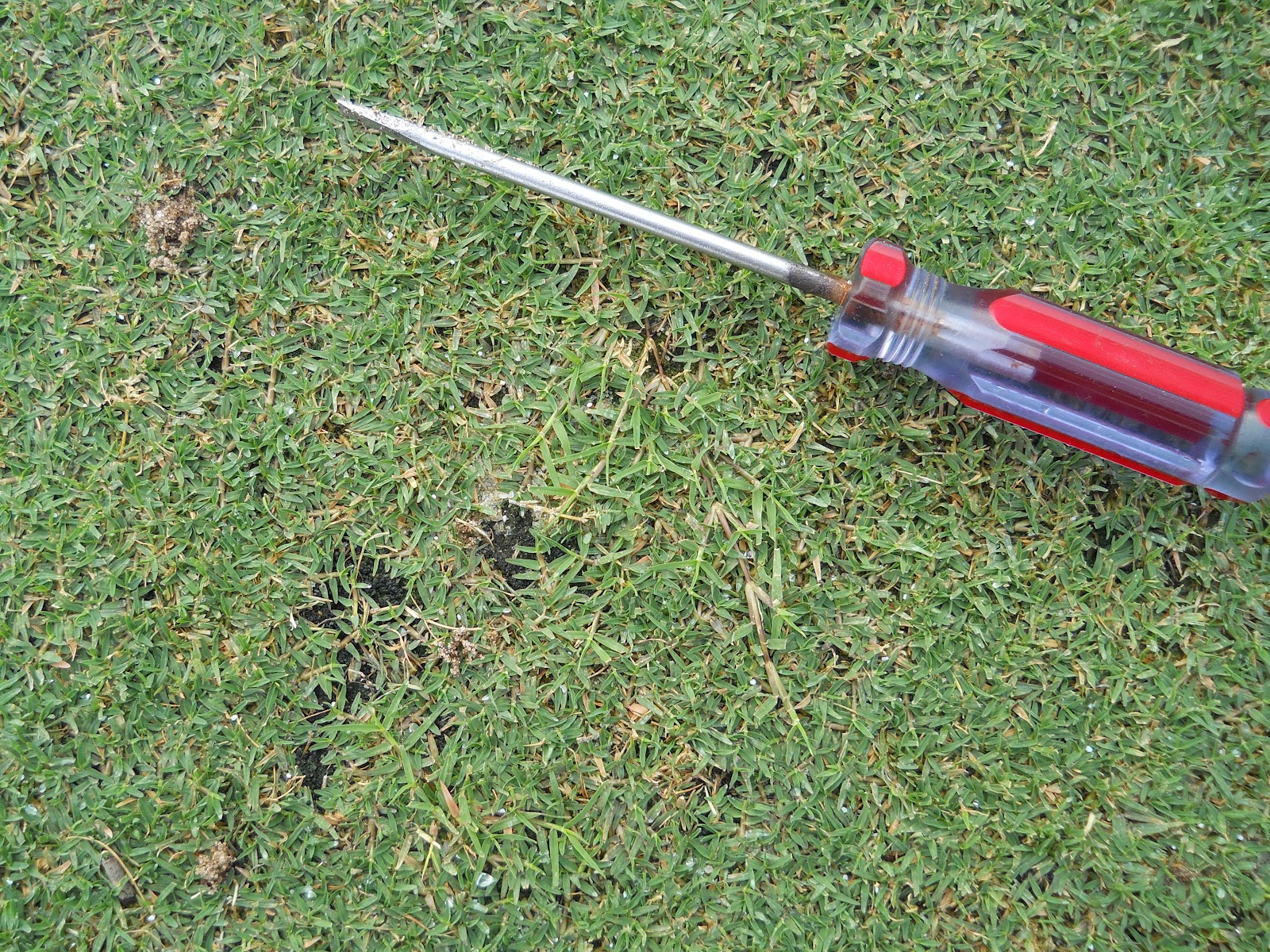
      We also continued our project of scouting the greens for weeds today. Because the turf is still relatively new, we must take precaution on the chemicals we apply. This forces us to remove noxious weeds by hand. Here is a picture of the types of weeds we are removing.

      Although difficult to see, above is a picture of some 419 bermudagrass that has emerged on the surface. Just below the screwdriver you can see the 419 rising above the surface. The 419 has a longer leaf blade and a distinctive growth pattern. These traits help us to isolate it on the MiniVerde surface. We then remove the plant and repair the green like repairing a ball mark. On a typical day we may pull 20-25 weeds from the surface over four acres.
      On Monday we applied an miticide to the greens. This product is designed to decrease nematode populations in the soil. Nematodes are a serious problem in turfgrass, especially in sandy soils. Here is a fact sheet on nematodes and the problems they present.
      We also started fertilizing the tees, fairways and weak areas on Monday. We fertilized with ammonium sulfate (21-0-0). This fertilizer will improve the color, quality and vigor of the turf.   
  • Tuesday -  Today we spiked, verticut, topdressed and fertilized the greens. The spiking was to break up the surface algae and allow the turf to cover in. The verticutting was intended to nick the MiniVerde plants, thus encouraging lateral growth. Finally the fertilizer we used was an (22-0-22) product designed to promote growth and replenish the potassium leached in the soil from increased irrigation.
      We also continued to clear sight lines around the course. Today we concentrated our efforts to the left of #1 tee. This area has become overgrown and the cutting back has been long overdue.
  • Wednesday - We mowed the surfaces today at a height of (.150"). As stated we will remain at this height until the surfaces are 95% covered.
      Wednesday also saw the completion of our putting green collar restoration. As of today all collars and weak areas around the greens have been sodded. We will continue to hand water them for another week to ensure a successful planting.
  • Thursday - Today we started our application of growth regulator to the course. We applied the growth regulator to all the turf sans the putting greens. This application will slow growth, therefore limiting scalping and improving turf quality.
  • Friday - We wrapped up all of our ongoing projects today. We finished our fertilizer and growth regulator applications. We also made an application of gypsum (CaSO4) to the greens. The gypsum will aid in flushing the salts from the soil. The increased salts associated with increased fertilization can be extremely detrimental to the turf. We typically apply gypsum twice per year. This year may see an increase to four or five. Here is a website explaining the benefits of gypsum applications.


Next Week 7/29-8/4
  • Continue mowing the greens at (.150"). A change in frequency may occur. Mowing everyday as opposed to every other may be necessary according to the health of the turf.
  • Fertilize the greens. We will be applying Urea (46-0-0) in liquid form to the surfaces. The different chemistry in Urea will help us to benefit from microbial activity beneath the surface.
  • Verticut the greens. One to two times as necessary
  • Topdress the surfaces.
  • Level sprinkler heads.
  • Begin refinishing course hardware. (i.e. tees, 150 pole, etc..)
  • Edge sand traps, cart paths, yardage signs, etc..
      Next week we will be devoted completely to reopening the course. We will wrap up any unfinished projects and focus 100% of or manpower on course conditioning. We expect to be in excellent condition on August 13th. Remember to follow the blog for more updates on the Players Club conversion and all things St. James Agronomy.

Saturday, July 21, 2012

PC Conversion Update - 7/21/12

      Five closed weeks down and only three weeks remain. August 13th is fast approaching and our workload is slowly gearing towards opening day. We mowed the greens three times this week and verticut once. They are becoming smoother everyday. We are currently at 75% coverage throughout the course. Here is a picture of the surface on Friday.


      We are currently mowing the greens at (.150"). We mowed our former surfaces at (.125"). We are getting closer and closer everyday. Our expectations for opening on August 13th are still right on schedule. Here is a recap of week five and a look ahead to week six.    

Last Week 7/15-7/21
  • Monday - We mowed the greens at a height of (.175). This height is equivalent to slightly less than 3/16". A standard height of cut is (.125") or 1/8". Today we also implemented hand watering into our irrigation schedule. Hand watering the weak areas of the green will help to supplement water where our irrigation deficiencies exist.
      Monday was also the beginning of our collar restoration. Here are some pictures of that process.

The first step is to cut a fine edge along the new putting surface. This will prevent the sod cutter from tearing the new surface.


Next, we cut the sod surrounding the green. We cut the sod at 24". This will match the width of the sod purchased from the sod farm. This matching will reduce waste and ultimately make our job move faster.

The following step was to clean up the cut turf from the collar area. We then used this "waste sod" in other areas around the course. Excessive traffic and low lying areas were the targets for our scraps from the collars.


These pictures above illustrate the collar waste I described. These traffic areas are normally sodded annually. By using these wasted sod chunks in these areas we are able to offset the cost of sodding the collars. In turn we re sod the collars and improve our traffic areas for relatively the same cost as sodding the traffic areas alone.

And last but certainly not least. A picture of the sod being laid and the finished product.


Here you see a finished collar on #18. This week we were able to finish the back nine and start on the front nine. We will complete this project in the middle of next week.
  • Tuesday - Today we continued work on the collars. We also began work on more sight lines throughout the course. Number 10 and 11 were are target teeing areas.
  • Wednesday - We mowed the greens today. The height of cut was lowered to (.165"). We also began the grooming process today. First we topdressed with a medium coat of sand/peat mix. Then we used a steel drag mat to move to mix into low areas on the green. The dragging helped to smooth the surface and "stand up" the turf. By standing the turf above the mix, we are encouraging new growth into the sand filled voids.
  • Thursday - One task that became vital on Thursday was the scouting of the surfaces. We are scouting the surface for noxious weeds that appear. Our inability to spray herbicide on the immature turf has left us with no option but hand removal. Expect a blog post mid next week detailing this job in its entirety.
  • Friday - Normally a slow day, Friday proved to be anything but that this week. We began the day by verticutting the greens. We verticut the greens at a zero setting. This setting does not cut into the surface. Our goal was to "tickle" the turf. This type of verticutting has many benefits. The two most beneficial are the smoothing of the surface and stimulation of new growth.
  •       Today we also made our first application of fungicide. This application will help to alleviate the symptoms of algae. See our post about algae here. The broad spectrum fungicide we used will also help to disrupt many other diseases that may be prevalent. 
          On Saturday we mowed the greens at (.150"). This our lowest height of cut to date. We plan to continue this decrease in height of cut through next week.

Next Week 7/22-7/28

  • Mow greens three times. Decreasing height each time. goal is to be at or around (.125").
  • Complete collar restoration.
  • Fertilize the greens with potassium nitrate. 
  • Continue scouting the surfaces for unwanted plants.
  • Initiate our project of leveling sprinkler heads.
  • Topdress and verticut the greens.
  • Spray wetting agent around the greens. Our increased irrigation has resulted in wet areas around the putting surfaces. This wetting agent will increase the infiltration rate of our irrigation water. The increased infiltration will keep the surrounds dry until we can decrease out irrigation frequency.
      With three weeks remaining our efforts are continuing to increase in anticipation of opening day. The increased coverage of the greens and finished collars will have the putting greens looking like a golf course again. We continue to encourage people to come out and see our progress. Also, keep following the blog for updates on everything from the St. James agronomy department.


Thursday, July 12, 2012

Members Club Update


While we have covered a lot of ground (literally), we still have a ways to go. There are a few fairways that are concerning and are receiving our upmost attention.

Our plans going forward are:

·         Continue to aggressively fertilize thin turf areas on a weekly basis to encourage growth

·         Spray wetting agents to help keep the soil moist

·         Spike and verticut to promote lateral growth

·         Topdress with a sand/peat soil mixture to help hold moisture and smooth the surface

Other steps we have taken include:

·         Ordered new irrigation heads – same style heads as used throughout Reserve Club -featuring improved precipitation rates

·         Purchased and installed several new antennas for field satellite controllers. Also purchased a new antenna for the base station to transmit an optimal signal.

·         Treated fairways with a nematicide to help control excessive nematode populations

·         Mowing with extremely sharp blades to reduce stress on the turf

·         Replaced a well-pump used for irrigation on the Cate nine which had expired.

We also have plans to beginning sodding some areas for quicker establishment.

Saturday, June 23, 2012

PC Conversion Update 6/23/12

      One week in and the conversion process is right on schedule. We accomplished all of the goals we set for ourselves this week. The greens are prepped and ready for sprigs. The only remaining task before the sprigs arrive is to fertilize the putting surfaces. We have made a small change in our planting preparations. The sprigs will now be arriving on Monday June 25th, rather than Tuesday. Modern Turf, the company supplying the sprigs, had a conflict in scheduling. We were able to squeeze the extra day into this past week to accommodate their schedule. Here is a rundown of last week's work and a look ahead to next week.

Last Week 6/17-6/23

Monday
  • Scalp greens to .070". Here is a detailed description of Mondays jobs.
  • Verticut greens, 100% overlap, 4 directions.
  • Clean-Up debris from scalping and verticutting.
Tuesday
  • Aerified greens - We aerified the greens in one direction. This will provide a channel in the surface to allow the MiniVerde roots to reach the soil below.
  • Began aerification plug clean up. First, we break up the cores using a steel drag mat. This separates the turf from the core soil. The soil will be left on the surface to provide a base for the sprigs. The organic matter will be collected and disposed of at our dump site.
  • Started the collar leveling project. Here is a short video of our trial run in April and below is a brief description of this job. 
      The collar levelling project begins with aggressive aerification. We rented specialized equipment just for this task. The alternative was to bid this job to an outside contractor. The estimate for this job was in excess of $30,000 and they requested that we close the course earlier than June 18th. 
      The aerifier we rented uses hollow core tines that are 1" wide and 10" deep. These tines allowed us to remove the maximum amount of soil an aerifier will pull. We went around the collars two times. The areas that are severely mounded were aerified 4-5 times. To the right is a picture of the aerifier in action.
      After aerification we cleaned up all of the cores on the collars. Then we applied water to soften the ground. We then rolled the collars repeatedly until we reached our desired slope. The watering continued, as needed, throughout the rolling. At left is a snapshot of the watering/rolling technique. This results of this method far exceeded our expectations. We originally thought this task would take three or four days. We wrapped up on Wednesday morning.


Wednesday
  • Completed collar leveling project
  • Finished aerification core cleanup
  • Remarked putting surface edge
  • Verticut collars. This helped to break up some of the soil matting. We then used a turbine blower to move the debris off the collars.
  • Began repairing damaged edges along the collars.


      To the right you can see a photo of a damaged collar after we repaired it. The yellow line indicates the green edge. The aerifier disrupted the turf past the point of turf survival. We filled the damaged areas with a sand/peat mix. Then we tamped the surface until the transition from green to collar was smooth. We will return and sod a 24" strip around the putting surface perimeters after the MiniVerde sprigs have matured. Waiting until maturation allows us to cut a clean edge around the green with a sod cutter.


Thursday
  • Finished repairing damaged collars.
  • Labor crew started clear cutting around all bridges.
  • Applied pre-plant fertilizer #1. We applied an organic fertilizer to the greens. This is the first of many applications of fertilizers prior to planting. However, this will be the only fertilizer applied beneath the topdressing mix. This, and all fertilizers were selected based on soil type, chemical soil tests and Modern Turf recommendations. Each fertilizer we will apply was specifically selected for our site.
  • Started topdressing greens. We topdressed our greens with an 87/13, sand/peat mix. We applied, roughly, 75 tons of sand over four acres of putting surfaces. Our goal was a quarter to a half inch of sand over the entire green.

Friday
  • Finished topdressing greens.
  • Finished fertilizing greens.
  • Continued clear cutting around bridges.
  • Calibrated the spreaders for each subsequent application. Three more prior to planting.
  • Rested!!

Next Week 6/24-6/30
  • Apply remaining pre-plant fertilizers to green.
  • Remark greens edges with striping paint.
  • Initiate a few side projects for closed summer
  • Plant sprigs - beginning Monday at 12:00.
  • Water, water, water.

      This past week was an extremely busy week for us. We crammed six days of work into five. The result was 19 greens prepped and ready for the MiniVerde sprigs. As stated, we will be planting the sprigs Monday at 12:00. I will post as many updates as possible through the week to keep you informed. Remember you can follow the blog on Twitter as well @stjamesturf.


Monday, June 18, 2012

PC Conversion Update - Monday June 18th

     We have officially started the conversion process at the Players Club today. Updates will be provided as often as possible through the next two weeks. We will also continue to run the weekly wrap-up to summarize each week of the conversion. As mentioned in last week's update, we began the cultivation of the green surfaces today. We made significant progress today and hope to continue that trend until the sprig arrival date of June 26th.
      Below is a rundown of the tasks we completed today.

Scalp the greens to .070"

     Here is a picture of #15 at the Players Club after the mowing today. We cut the greens with 100% overlap in two directions. Basically, we quadruple cut the greens at a height of .070". Mowing at this height of cut and intensity eliminates the chance of existing turf survival. The scalping of turf starts the process of removing the foliage. The leaf removal aides in allowing better soil to sprig contact.


Aggressively verticut


    At left, you see a picture of us verticutting. Verticutting is exactly as it sounds, vertical mowing. The blades on this mower slice into the turf canopy. This slicing removes organic matter, foliage and reduces the barrier between the soil and surface. We verticut over the surface four times in varying directions.


      Here you can see a close up of the surface after verticutting. You can see the remnants of the organic matter that was removed. You can also see the slits that the verticutter made. These voids will eventually be filled by our sand/peat mix. This will allow the roots of the Mini Verde to penetrate into the soil beneath.


Clean Up

      The above pictures detail the first step in the clean-up process. We used our Rake-o-Vac to remove a majority of the loose debris. Above right, you can see the green before and after the Vac.


      Here you can see the final steps of the clean-up process. We blow the remaining debris into the center of the green. Then we shovel the remains into a cart and haul off to our dump site.

      The scalping and verticutting were the first two steps in the site preparation process. Tomorrow we will aerify the greens and begin the collar leveling project. Check back with the blog tomorrow evening for updates. You can also keep up to date with us on Twitter. Follow @stjamesturf.