Showing posts with label topdressing. Show all posts

Monday, June 9, 2014


Members Club Conversion Update

6/9/14

All the front nine greens are sprigged!!!

     The process went very well. Again, Mother Nature lent a helping hand. About the time the last sprig hit the ground, the sky opened up, drenching us with 1/4" of rain.
     Below are a few photos of the tasks performed during the week.


Spreading soil admendments
Hand-shaking sprigs


Laying sprigs on the practice green
Topdressing the sprigs with a sand and peat mix

Cutting-in the sprigs


Water! Water! Water!


Wednesday, May 28, 2014

MC Conversion Update - 5/28/14


     The conversion from Tifdwarf to MiniVerde has officially started. We are thrilled to have Day One in the books. Mother Nature blessed us with perfect weather. Mid 80s. Sunny. Breezy. Cleanup after verticutting and aerifying went very well.
     We plan to keep the updates coming along with a recap of we've accomplished. Stay tuned!

     Below are a few photos from yesterday's action. Our goal was to remove as much of the old vegetation as possible.

Adam - verticutting the greens - five different directions!


Ed and (Drew in the background) blowing off debris after verticutting


Pushing off plugs after aerifying--two directions.

Friday, May 16, 2014

PC Closed Day

       The Players Club was closed Tuesday afternoon and all day on Wednesday. The main reason for closing was to apply a soil fumigant to the greens. This application targeted the parasitic nematodes that are abundantly present in our greens soil. The fumigant application was applied Tuesday afternoon and required a 24 entry restriction. We used this closed time to complete other time consuming tasks as well.
        Tuesday afternoon, following LGA, we began the Curfew application. This product was applied by Southern Soils via Harrell's LLC. We will post a detailed description of Curfew and its effects next week. Here are some pictures of the application in progress.

The applicator is attached to the rear of the tractor. It is injected into the soil as a liquid. It then volatilizes as a gas and moves throughout the soil and kills the nematodes on contact.

You can see the slits being cut into the soil. This is the site where the liquid is injected. We roll and water immediately after to ensure the slits are sealed.
       The pictures illustrate the application process. Our actions immediately following the application are what guarantee the success of the fumigant.

Associate Juan Diaz Garcia rolling the surfaces.


      Immediately following the application we rolled the greens. The rolling helps to reseal the slits made by the applicator. We then irrigate the greens with a moderate amount of water, roughly one-tenth of an inch. These processes aid in sealing the slits and keeping the gases at the target site. We then continue to water frequently for the next 24 hours. Once play resumes on the course, the active ingredient has mostly dissipated and it has already moved throughout the soil profile. 
      On top of fumigating the greens we were also able to tackle some other management practices during our closed period. 
      The most labor intensive area on our golf courses are the bunkers. Daily raking, mowing the faces, edging and redistributing sand are extremely arduous tasks. Coupled with active golfers, the amount of time to complete these jobs can be tripled. We took advantage of our "golfer free" course to mow the faces, edge and clean all the traps on the property. This took our staff half of the day Tuesday and all day Wednesday. This process is typically done once a month. 
       We fertilized the rough with ammonium sulfate fertilizer Wednesday morning. This will help to jump start the turf to aid in filling in some weak areas. We use 21-0-0 because of the rapid response and cost effectiveness. You should begin to notice the results within three to five days. 
      Wednesday afternoon we sprayed all the broad leaf weeds on the golf course. Broad leaf weeds can be an eyesore to any golf course, especially in the spring while the bermudagrass is returning from dormancy. We completed the spraying of 40+ acres in three hours. A task that can take four to five afternoons was finished with ease while we were closed.
       And last but not least we topdressed the greens with a medium coating of 100% sand. Because of our weak greens in April we have been fertilizing regularly. This causes flushes of growth. The growth leads to more leaf surface, which in turn will lead to a "thatchy surface". The topdressing sand helps to dilute the thatch and provide a smoother ball roll. Topdressing is an integral part of managing a good putting surface.
      As you can see, we accomplished a lot during our closed period. We understand the closing takes away from the golf schedule. We also understand that our membership loves to golf. We cannot state enough how appreciative we are to have closed periods during the growing season. This helps us complete work more effectively and efficiently. The result is a quieter and better looking golf course. Again, we appreciate your patience and understanding when we close our golf courses.


Wednesday, April 2, 2014

Welcome back Spring...

      The winter is finally over and the mild weather conditions have finally allowed us to start pushing the greens. This week we made our first topdressing application of the 2014 season. However, you may have noticed that this wasn't the typical brown sand that we normally use. The sand we use for our first topdressing is actually black. The darker tint helps to absorb heat at the surface. This promotes a faster green up and a slightly earlier start to the growing season. Below are some pictures of the sand and how it looks when applied to the turf.


Monday, April 29, 2013

Typical Double Tee Day

      This past Wednesday at the Players Club we took advantage of the beautiful weather and began to refocus our energy towards the growing Bermudagrass. The single tee in the afternoon allows us to direct golf to either side of the course therefore opening up nine holes for us to finish our work. The open nine increases our production by twofold and causes zero disruption to the golfers. We are able to mow rough, edge, trim and even complete some minor projects each afternoon without bothering the golfers and their guests.

      On Wednesday, for instance, we needletined greens, topdressed, mowed rough, mowed bunker faces and fixed a broken drain in #3 waste bunker. Here are some pics from the days work.

Topdresser in action.


A perfectly topdressed green.


Brushing the sand into the canopy.


Water the remaining sand off of the surface.


The crew mowing bunker faces and rough.


Asst. Superintendent Chris Batson fixing a broken drain.


Ricardo Hehua redistributing sand in the traps.

       The photos illustrate the amount of work we are able to complete in an afternoon. We don't disrupt play with our mowers and sprayers, and we complete our work in a timely manner without pausing for golfers to pass through. The double/single tee has been the most effective course management tool to be adopted on the plantation. We will continue to utilize this golfer/maintenance friendly schedule to complete our management practices around, not through, the golfing schedule.

Tuesday, October 2, 2012

Players Club - Overseed Week

      The Players Club was closed the week of September 25th primarily for overseeding. Although overseeding was our main goal we were also able to complete some other tasks. Here is a recap of last week's projects.

Monday
      While we weren't closed, we were able to begin the overseeding process on Monday afternoon. We applied a wetting agent to the tee tops and green surround. This particular product will aid in water retention at the surface. This will keep the moisture near the surface and readily available for the seed.

Tuesday
      Today was our busiest day of the overseed week. We began the day by topdressing the greens with a medium to heavy layer of straight sand. The heavy application rate was designed to help smooth the greens.
      In the mid morning we started overseeding fairways. This process takes approximately six hours to complete and used 17,500 pounds of ryegrass seed.
      The tees were seeded as well on Tuesday. This was started in the afternoon and generally takes between three and four hours and used 2,000 pounds of ryegrass seed.

Wednesday
      Today we were able to finally correct our turf issues on some of the greens on the back nine. Modern Turf (supplier of our sprigs) agreed to compensate us with 2100 sq ft of MiniVerde sod to replace our weak areas on 12 and 13. Below is a illustrated rundown of the process of resodding of these areas.

Removal of existing weak turf.


Light tilling of soil.


Addition of new soil. A 87/13 sand peat mix.


Using a vibrating tamp to smooth the surface.


Finished sub grade.


Aligning the new sod.

Unrolling the sod

Tucking the seams.
Finished surface.
      Sodding these areas on 12 and 13 took almost twelve hours total. We finished up on number 13 on Thursday at 11 A.M.. As of posting, these areas will be played as a free drop. Should your ball lie on these areas of the green you may place the ball at some point on the green no nearer to the hole.

Thursday
      We wrapped up our sod project in the morning and refocused our attention to overseeding. We overseeded green surrounds in the afternoon on Thursday. This task takes roughly six hours and used 4,000 pounds of ryegrass seed.

Friday
      Today we applied our preemergent herbicide to the perimeters of all of the overseeded turf. This product will prevent any wayward ryegrass seed from germinating outside of the target overseed areas. The application of this product is done with a walk behind sprayer and typically takes about three to four hours.

      Overall we had an excellent closed week for overseeding. Mother Nature cooperated enough to allow us the time to complete all of our goals. Our focus can now shift to preparation for the Member-Guest tournament in late October. Keep following the blog for more updates from the St. James agronomy team.

Saturday, August 11, 2012

PC Conversion Update - 8/12

      Less than 24 hours and the Players Club is open again. It's been a grueling, but rewarding summer. We are very excited to finally unveil the new greens to the membership. The greens rolled (9'4") on the stimpmeter on Saturday morning. We anticipate a (9.5') roll on Monday. Here are some pictures of the surface on Saturday.


      Here are two pictures from five weeks ago, only one week removed from planting.


     The photos illustrate just how far we have progressed in a short period of time. On Monday you will be able to experience for yourself the quality of the new putting surfaces.
    
     In our final week of preparation mother nature decided not to cooperate. The inconvenient rain events pushed our work schedules into the evenings on Friday and Saturday to accomplish everything we wanted by Monday. Here is a rundown of the final tasks leading up to opening day.

Last Week 8/5 - 8/11
  • Monday - We mowed the greens at (.140") today. The staff continued their bunker work (mow, edge, redistribute sand). We also started our edging work today (cart paths, yard markers, etc..).
      Another project that began today was the edging of the green surfaces. This task is new to the Players Club this year. The goal with edging the greens is to prevent encroachment from the collar turf. The collars consist of 419 bermudagrass. In years past there has been a major encroachment problem at the Players Club. We feel strongly that regular edging will prevent any future issues associated with edge contamination.
Associate Ricardo Hehua edging the green.
After the green edging.
  • Tuesday - Mother Nature washed us out on Tuesday. She dropped nearly three inches of rain over the course.
  • Wednesday - Today brought some more rain onto the Players Club. The course was completely saturated thus limiting the amount of work done for the second straight day.
  • Thursday - The greens were cut at (.130") today. The average golf course green is mowed at (.125). Our target height is (.120) for opening day. Thursday also allowed us to resume our bunker and edging work.  
       We were able to make our first growth regulator application to the greens. The growth regulator helps to maintain green speeds throughout the day. Without regulation the surfaces would grow, unrestricted. The result is fast surface in the morning and a slower ball roll in the afternoon. There are many agronomic benefits to growth regulation as well. However none more important than ball roll consistency.
       We topdressed the greens as well Thursday. Instead of using our sand/peat mix we switched over to straight sand. This sand was designed specifically for MiniVerde greens. The sand is of fine texture. This texture allows it to work into the tight MiniVerde canopy. This sand will help the greens to maintain smoothness and correct imperfections on the surface.
  • Friday - We dropped our height of cut to our target of (.120") today. We saw some increased scalping and discoloration. These signs our normal when mowing this low for the first time. Increased frequency, growth regulation, topdressing and rolling will correct this issue over the next few days.
      We applied insecticide to the course perimeters today. Our target pest is armyworms. Armyworms our very small pets that feed on the leaves of bermudagrass. They overwinter in forested areas. Upon hatching they move into grassed areas to feed. Armyworms get their name from their feeding characteristics. Literally thousands of worm can be seen feeding on leaves at any one time. From a distance the turf may appear to be moving as you approach the affected area. These pests can be devastating to turf if left untreated. Typically, one to two applications are necessary per year to reduce the damage done by armyworms. Here is a fact sheet with more information on armyworms.
  • Saturday - Today we made a wetting agent application to the greens. This particular wetting agent is designed to help move water through  the soil. The increased movement will help to dry the green and provide a firmer putting surface.
      Saturday could be categorized as cramming for the big exam. We set up all the golf course hardware, cleaned debris and wrapped up all ongoing projects. This was our final full working day before opening. We will be hosting a small group of players on Sunday and we wanted to present the entire course in the best condition possible. Tomorrow we will set up the course as usual and watch as our hard work this summer can finally be enjoyed.

      This post will wrap up the Players Club conversion series. Stay tuned throughout the remainder of the summer and fall for more news from the St. James agronomy team. We will continue to use this blog as a tool to communicate our operations and projects to the membership.
     

Saturday, July 28, 2012

PC Conversion Update - 7/28/12

      We have definitely reached the home stretch now. Only two weeks remain until the greens will be unveiled. August 13th is fast approaching and we are gearing all of our attention towards opening the course. With only 10 working days left its time to wrap up ongoing projects and begin prepping the course for play. Here is a recap of last week and a brief look ahead to next.

Last Week 7/22-7/28
  • Monday - We mowed the greens at a height of (.150"). We are holding steady at this height until the last week of the grow-in. We are still trying to fill in a few areas and the increased leaf surface will help to accomplish that.
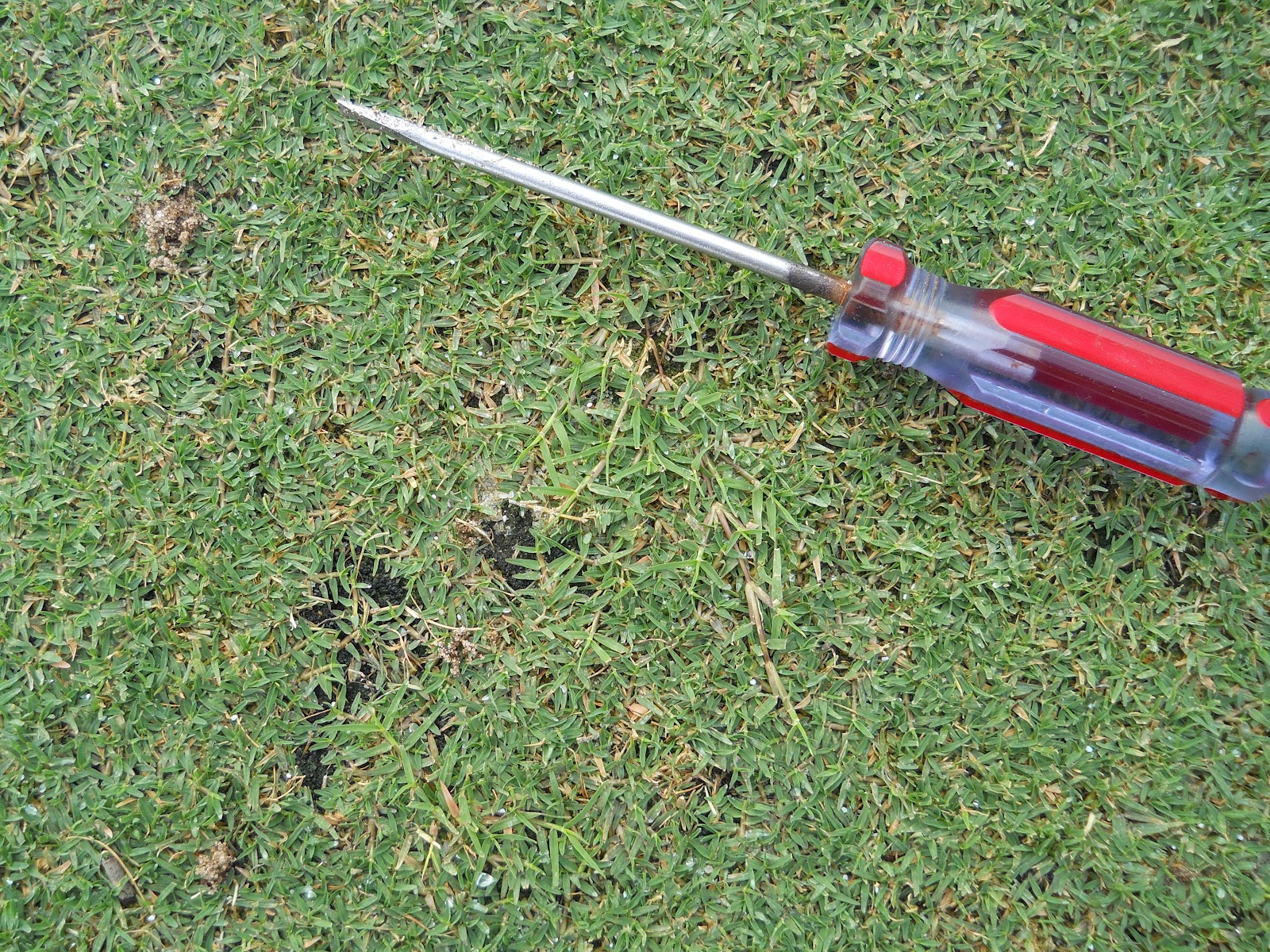
      We also continued our project of scouting the greens for weeds today. Because the turf is still relatively new, we must take precaution on the chemicals we apply. This forces us to remove noxious weeds by hand. Here is a picture of the types of weeds we are removing.

      Although difficult to see, above is a picture of some 419 bermudagrass that has emerged on the surface. Just below the screwdriver you can see the 419 rising above the surface. The 419 has a longer leaf blade and a distinctive growth pattern. These traits help us to isolate it on the MiniVerde surface. We then remove the plant and repair the green like repairing a ball mark. On a typical day we may pull 20-25 weeds from the surface over four acres.
      On Monday we applied an miticide to the greens. This product is designed to decrease nematode populations in the soil. Nematodes are a serious problem in turfgrass, especially in sandy soils. Here is a fact sheet on nematodes and the problems they present.
      We also started fertilizing the tees, fairways and weak areas on Monday. We fertilized with ammonium sulfate (21-0-0). This fertilizer will improve the color, quality and vigor of the turf.   
  • Tuesday -  Today we spiked, verticut, topdressed and fertilized the greens. The spiking was to break up the surface algae and allow the turf to cover in. The verticutting was intended to nick the MiniVerde plants, thus encouraging lateral growth. Finally the fertilizer we used was an (22-0-22) product designed to promote growth and replenish the potassium leached in the soil from increased irrigation.
      We also continued to clear sight lines around the course. Today we concentrated our efforts to the left of #1 tee. This area has become overgrown and the cutting back has been long overdue.
  • Wednesday - We mowed the surfaces today at a height of (.150"). As stated we will remain at this height until the surfaces are 95% covered.
      Wednesday also saw the completion of our putting green collar restoration. As of today all collars and weak areas around the greens have been sodded. We will continue to hand water them for another week to ensure a successful planting.
  • Thursday - Today we started our application of growth regulator to the course. We applied the growth regulator to all the turf sans the putting greens. This application will slow growth, therefore limiting scalping and improving turf quality.
  • Friday - We wrapped up all of our ongoing projects today. We finished our fertilizer and growth regulator applications. We also made an application of gypsum (CaSO4) to the greens. The gypsum will aid in flushing the salts from the soil. The increased salts associated with increased fertilization can be extremely detrimental to the turf. We typically apply gypsum twice per year. This year may see an increase to four or five. Here is a website explaining the benefits of gypsum applications.


Next Week 7/29-8/4
  • Continue mowing the greens at (.150"). A change in frequency may occur. Mowing everyday as opposed to every other may be necessary according to the health of the turf.
  • Fertilize the greens. We will be applying Urea (46-0-0) in liquid form to the surfaces. The different chemistry in Urea will help us to benefit from microbial activity beneath the surface.
  • Verticut the greens. One to two times as necessary
  • Topdress the surfaces.
  • Level sprinkler heads.
  • Begin refinishing course hardware. (i.e. tees, 150 pole, etc..)
  • Edge sand traps, cart paths, yardage signs, etc..
      Next week we will be devoted completely to reopening the course. We will wrap up any unfinished projects and focus 100% of or manpower on course conditioning. We expect to be in excellent condition on August 13th. Remember to follow the blog for more updates on the Players Club conversion and all things St. James Agronomy.

Saturday, July 21, 2012

PC Conversion Update - 7/21/12

      Five closed weeks down and only three weeks remain. August 13th is fast approaching and our workload is slowly gearing towards opening day. We mowed the greens three times this week and verticut once. They are becoming smoother everyday. We are currently at 75% coverage throughout the course. Here is a picture of the surface on Friday.


      We are currently mowing the greens at (.150"). We mowed our former surfaces at (.125"). We are getting closer and closer everyday. Our expectations for opening on August 13th are still right on schedule. Here is a recap of week five and a look ahead to week six.    

Last Week 7/15-7/21
  • Monday - We mowed the greens at a height of (.175). This height is equivalent to slightly less than 3/16". A standard height of cut is (.125") or 1/8". Today we also implemented hand watering into our irrigation schedule. Hand watering the weak areas of the green will help to supplement water where our irrigation deficiencies exist.
      Monday was also the beginning of our collar restoration. Here are some pictures of that process.

The first step is to cut a fine edge along the new putting surface. This will prevent the sod cutter from tearing the new surface.


Next, we cut the sod surrounding the green. We cut the sod at 24". This will match the width of the sod purchased from the sod farm. This matching will reduce waste and ultimately make our job move faster.

The following step was to clean up the cut turf from the collar area. We then used this "waste sod" in other areas around the course. Excessive traffic and low lying areas were the targets for our scraps from the collars.


These pictures above illustrate the collar waste I described. These traffic areas are normally sodded annually. By using these wasted sod chunks in these areas we are able to offset the cost of sodding the collars. In turn we re sod the collars and improve our traffic areas for relatively the same cost as sodding the traffic areas alone.

And last but certainly not least. A picture of the sod being laid and the finished product.


Here you see a finished collar on #18. This week we were able to finish the back nine and start on the front nine. We will complete this project in the middle of next week.
  • Tuesday - Today we continued work on the collars. We also began work on more sight lines throughout the course. Number 10 and 11 were are target teeing areas.
  • Wednesday - We mowed the greens today. The height of cut was lowered to (.165"). We also began the grooming process today. First we topdressed with a medium coat of sand/peat mix. Then we used a steel drag mat to move to mix into low areas on the green. The dragging helped to smooth the surface and "stand up" the turf. By standing the turf above the mix, we are encouraging new growth into the sand filled voids.
  • Thursday - One task that became vital on Thursday was the scouting of the surfaces. We are scouting the surface for noxious weeds that appear. Our inability to spray herbicide on the immature turf has left us with no option but hand removal. Expect a blog post mid next week detailing this job in its entirety.
  • Friday - Normally a slow day, Friday proved to be anything but that this week. We began the day by verticutting the greens. We verticut the greens at a zero setting. This setting does not cut into the surface. Our goal was to "tickle" the turf. This type of verticutting has many benefits. The two most beneficial are the smoothing of the surface and stimulation of new growth.
  •       Today we also made our first application of fungicide. This application will help to alleviate the symptoms of algae. See our post about algae here. The broad spectrum fungicide we used will also help to disrupt many other diseases that may be prevalent. 
          On Saturday we mowed the greens at (.150"). This our lowest height of cut to date. We plan to continue this decrease in height of cut through next week.

Next Week 7/22-7/28

  • Mow greens three times. Decreasing height each time. goal is to be at or around (.125").
  • Complete collar restoration.
  • Fertilize the greens with potassium nitrate. 
  • Continue scouting the surfaces for unwanted plants.
  • Initiate our project of leveling sprinkler heads.
  • Topdress and verticut the greens.
  • Spray wetting agent around the greens. Our increased irrigation has resulted in wet areas around the putting surfaces. This wetting agent will increase the infiltration rate of our irrigation water. The increased infiltration will keep the surrounds dry until we can decrease out irrigation frequency.
      With three weeks remaining our efforts are continuing to increase in anticipation of opening day. The increased coverage of the greens and finished collars will have the putting greens looking like a golf course again. We continue to encourage people to come out and see our progress. Also, keep following the blog for updates on everything from the St. James agronomy department.


Saturday, July 14, 2012

PC Conversion Update - 7/14/12

     We have now reached the halfway point of the conversion. Here is a video with Conrad Broussard and Grayson Grainger with a brief recap of our progress.
      The greens are covering as planned and we are getting excited to start grooming them for play. Here are some pics of the surfaces from Friday.


     We have come a long way from three weeks ago at planting. Here is a photo of a green after planting only three weeks ago.

      This past week we were able to shift our attention to a few projects away from the greens. Here is a recap of last week and a look ahead to next.

Last Week 7/8-7/14
  • Monday - We mowed the greens for the second time on Monday. The height of cut remained at (.200"). We applied Calcium Nitrate (15-0-0) to the greens and we sprayed the greens with a different variety of plant stimulants.
  • Tuesday - Sprayed greens with Potassium Nitrate. The potassium is a necessary supplement to avoid deficiencies. Our increased irrigation associated with grow-in can flush important nutrients like potassium from the soil. This will help correct those deficiencies for the short term until we can apply a granular product.
      On Tuesday we also started and a project associated with sight lines from the tee boxes. The surrounds of #2 and #8 tee complexes have become overgrown to the point of disrupting play. We cleared these areas back to increase the sight line from the tee. Here is an example of that job in progress.
Sight line from #2 tee

  • Wednesday - We mowed the greens for the third time today. The height of cut remained at (.200"). We will remain at this height for at least one more week.
      Wednesday was also our wall to wall insecticide spray. We sprayed a combination product that targets mole crickets, grub worms and ants. This took approximately six hours to complete.
      We resumed work on the ladies tee on #6 today. Here is a series of pictures detailing the work.


      The final picture shows the contractor installing the turf. The new turf is designed to support a golf tee. The need for additional support is unnecessary with this type of artificial surface. Pictures of the completed project will be available early next week.
  • Thursday - We topdressed the greens with a light to medium layer of sand/peat mix. This application will help to keep the surface smooth. Additionally, the peat will aid in water retention at the surface.
  • Friday - The greens were fertilized with Ammonium Sulfate (21-0-0). This fertilizer will promote leaf growth, which in turn helps to produce carbohydrates. These carbs will be used to produce new plants and encourage the surfaces to fill in.

Next Week 7/15-7/21
  • Mow the greens three times. An adjustment in height may occur. This will be dependant on the condition of the surface through the week.
  • Lightly groom the greens. This will be done with a steel drag mat, brush, or coco mat. Again, this will be dependant on the green's condition.
  • Fertilize the greens with nitrogen fertilizer.
  • Topdress the greens one or two times.
  • Begin work on collars. Here is a brief description of that job.

      With a busy week behind us and a busy week ahead we continue to keep focused on preparing the greens for August 13th. We encourage all of you to keep stopping by and checking our progress. The collars should be finished late next week. At this point, the definition of the surfaces will take shape.
      Remember to adhere to our irrigation schedule if you should stop by. At this time we are watering four times a day, 7am, 11am, 3pm, & 7pm. These cycles run approximately 45 minutes. Anytime outside of these windows would be ideal to visit. And of course continue to follow the blog for updates from the staff at St. James.