The month of May is the time of year when the nematode populations begin to rise. This is the time of year when we want to curb the increasing numbers. The product we chose to apply this season is Curfew, a soil fumigant. We have or are applying Curfew to the rough at the Founders, Reserve and Members and to the greens at the Players Club.
Curfew is to be applied by a certified applicator. We contract our application through Harrell's LLC. Before they arrive, we receive a prep kit detailing the application process. Within the kit is a brief Q&A for us to review and better inform our membership about the proper Curfew procedures. Below is a brief version of the Q&A.
What is the smell?
The smell is the active ingredient in Curfew. It normally goes away shortly after application. The entire product dissipates within 24-48 hours.
What is a soil fumigant?
A chemical that is injected as a liquid below the soil surface. The liquid then volatilizes and moves through the soil to kill the target nematodes.
How does Curfew work?
As Curfew volatilizes, it creates a zone of protection around turf roots. When a nematode comes into contact with Curfew, it absorbs a lethal dose and dies.
Can Curfew be a risk to humans?
Yes. If used incorrectly, prolonged exposure to the gas or liquid can cause health problems. The application method is designed to keep Curfew in the soil. This keeps the gas from coming into contact with people or pets. This is why only specially trained applicators, who take specific precautions to limit exposure, are allowed to make the application.
When is it safe to return to the treated area?
You can return to the treated areas 24 hours after application. At this time, most of the active ingredient has dissipated.
Where can I find additional information?
Dow AgroSciences can provide you with additional information about Curfew. You can contact via phone at (800)-255-3726 or visit www.dowagro.com/turf.
Showing posts with label nematodes. Show all posts
Showing posts with label nematodes. Show all posts
Thursday, May 22, 2014

Friday, May 16, 2014
PC Closed Day
The Players Club was closed Tuesday afternoon and all day on Wednesday. The main reason for closing was to apply a soil fumigant to the greens. This application targeted the parasitic nematodes that are abundantly present in our greens soil. The fumigant application was applied Tuesday afternoon and required a 24 entry restriction. We used this closed time to complete other time consuming tasks as well.
Tuesday afternoon, following LGA, we began the Curfew application. This product was applied by Southern Soils via Harrell's LLC. We will post a detailed description of Curfew and its effects next week. Here are some pictures of the application in progress.
The pictures illustrate the application process. Our actions immediately following the application are what guarantee the success of the fumigant.

Tuesday afternoon, following LGA, we began the Curfew application. This product was applied by Southern Soils via Harrell's LLC. We will post a detailed description of Curfew and its effects next week. Here are some pictures of the application in progress.
 |
| The applicator is attached to the rear of the tractor. It is injected into the soil as a liquid. It then volatilizes as a gas and moves throughout the soil and kills the nematodes on contact. |
 |
| You can see the slits being cut into the soil. This is the site where the liquid is injected. We roll and water immediately after to ensure the slits are sealed. |
 |
| Associate Juan Diaz Garcia rolling the surfaces. |
Immediately following the application we rolled the greens. The rolling helps to reseal the slits made by the applicator. We then irrigate the greens with a moderate amount of water, roughly one-tenth of an inch. These processes aid in sealing the slits and keeping the gases at the target site. We then continue to water frequently for the next 24 hours. Once play resumes on the course, the active ingredient has mostly dissipated and it has already moved throughout the soil profile.
On top of fumigating the greens we were also able to tackle some other management practices during our closed period.
The most labor intensive area on our golf courses are the bunkers. Daily raking, mowing the faces, edging and redistributing sand are extremely arduous tasks. Coupled with active golfers, the amount of time to complete these jobs can be tripled. We took advantage of our "golfer free" course to mow the faces, edge and clean all the traps on the property. This took our staff half of the day Tuesday and all day Wednesday. This process is typically done once a month.
We fertilized the rough with ammonium sulfate fertilizer Wednesday morning. This will help to jump start the turf to aid in filling in some weak areas. We use 21-0-0 because of the rapid response and cost effectiveness. You should begin to notice the results within three to five days.
Wednesday afternoon we sprayed all the broad leaf weeds on the golf course. Broad leaf weeds can be an eyesore to any golf course, especially in the spring while the bermudagrass is returning from dormancy. We completed the spraying of 40+ acres in three hours. A task that can take four to five afternoons was finished with ease while we were closed.
And last but not least we topdressed the greens with a medium coating of 100% sand. Because of our weak greens in April we have been fertilizing regularly. This causes flushes of growth. The growth leads to more leaf surface, which in turn will lead to a "thatchy surface". The topdressing sand helps to dilute the thatch and provide a smoother ball roll. Topdressing is an integral part of managing a good putting surface.
As you can see, we accomplished a lot during our closed period. We understand the closing takes away from the golf schedule. We also understand that our membership loves to golf. We cannot state enough how appreciative we are to have closed periods during the growing season. This helps us complete work more effectively and efficiently. The result is a quieter and better looking golf course. Again, we appreciate your patience and understanding when we close our golf courses.
Tuesday, April 15, 2014
Troon site visit
One of our bi-annual site visits from Troon's senior agronomist was held last week. He toured all four courses and offered recommendations for improvements plantation wide. One of the areas of concern to many are the Mini Verde greens at the Players Club. He assessed our unique circumstances and offered the following as a plan of action.
Our first and most immediate change will be to raise our mowing heights. We will be raising our height of cut by one hundredth of an inch. This will reduce stress to the plant, ultimately aiding in the recovery phase. We will also be reducing our rolling frequency. This will lessen the burden to the plant and allow it to recuperate faster. These factors will affect the golfer the most. Our green speeds will be moderate for the time being until we show improvement.
Another area of concern was our nematode counts. We sent samples to the NCDA and our results indicated that our hazard indexes are high. We have since secured a contractor to apply nematicide to our greens. The product is applied directly into the soil and requires 24 hours before re-entry. This will force us to close for an additional day in May. We have scheduled this application for May 13th and will require the course to be closed on May 14th. We apologize for any inconvenience and appreciate your patience.
Our long term plans on managing the greens will have more of an indirect impact on current conditions. We will continue to assess our managements methods in regards to preparations for winter. We plan to adjust our practices to enter winter healthier than last season. We will also anticipate a long and cold winter versus the traditional mild, temperate season. The core areas of focus will be fertilization, site conditions, irrigation and pesticide use. Again, we appreciate your patience and encourage you to keep following the blog for updates from the agronomy team at St. James.
Our first and most immediate change will be to raise our mowing heights. We will be raising our height of cut by one hundredth of an inch. This will reduce stress to the plant, ultimately aiding in the recovery phase. We will also be reducing our rolling frequency. This will lessen the burden to the plant and allow it to recuperate faster. These factors will affect the golfer the most. Our green speeds will be moderate for the time being until we show improvement.
Another area of concern was our nematode counts. We sent samples to the NCDA and our results indicated that our hazard indexes are high. We have since secured a contractor to apply nematicide to our greens. The product is applied directly into the soil and requires 24 hours before re-entry. This will force us to close for an additional day in May. We have scheduled this application for May 13th and will require the course to be closed on May 14th. We apologize for any inconvenience and appreciate your patience.
Our long term plans on managing the greens will have more of an indirect impact on current conditions. We will continue to assess our managements methods in regards to preparations for winter. We plan to adjust our practices to enter winter healthier than last season. We will also anticipate a long and cold winter versus the traditional mild, temperate season. The core areas of focus will be fertilization, site conditions, irrigation and pesticide use. Again, we appreciate your patience and encourage you to keep following the blog for updates from the agronomy team at St. James.
Thursday, May 30, 2013
NC State Trials at the PC
Over the next month North Carolina State extension specialists, Matt Martin and Travis Gannon will be conducting field trials at the Players Club. The trials will take place on the 13th and 16th fairways. There will be three plots total laid out on the two fairways. Two plots will be for testing a herbicide and one will be for testing a nematicide (treatment for nematodes).
The herbicide is being tested for its efficacy in transitioning from ryegrass to Bermuda in fairways. The nematicide is being tested to determine the amount of phytotoxicity caused to ryegrass turf stands. Each product will be tested using multiple rates and application frequencies. The plots will be tested and checked weekly. Here are some pictures of the plots and the guys mapping them out.
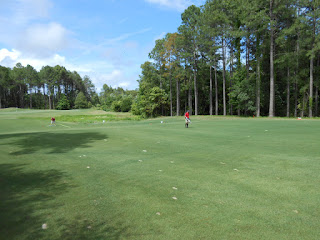


The herbicide is being tested for its efficacy in transitioning from ryegrass to Bermuda in fairways. The nematicide is being tested to determine the amount of phytotoxicity caused to ryegrass turf stands. Each product will be tested using multiple rates and application frequencies. The plots will be tested and checked weekly. Here are some pictures of the plots and the guys mapping them out.


Thursday, December 20, 2012
Looking ahead - GCM maintenance schedule 2013
This week we are going to tackle the arduous task of plotting the maintenance schedule for 2013. This schedule includes the dates the clubs are closed and what tasks we will be performing. The tasks for each club will be similar, however the dates will be different. This calendar is an overview of the entire year. You can expect detailed posts throughout the year highlighting how we perform each job.
January
9th - Founders - Closed all day to apply post-emergent herbicide to the non-overseeded rough.
10th - Members - Closed all day to apply post-emergent herbicide to the non-overseeded rough and add colorant to the greens.
15th - Players - Closed all day to apply post-emergent herbicide to the non-overseeded rough and add colorant to the greens.
16th - Reserve - Closed all day to apply post-emergent herbicide to the non-overseeded rough.
February
9th - Members - Nine holes closed to add colorant to the greens.
10th - Members - Nine holes closed to add colorant to the greens.
12th - Players - Closed all day to apply pre-emergent herbicide to the entire course and add colorant to the greens.
13th - Reserve - Closed all day to apply pre-emergent herbicide to the entire course.
16th - Members - Nine holes closed to add colorant to the greens.
20th - Founders - Closed all day to apply pre-emergent herbicide to the entire course.
21st - Members - Closed all day to apply pre-emergent herbicide and lime to the entire course.
March
19th - Founders - Closed after double tee to fertilize (21-0-0) the non-overseeded rough.
20th - Reserve - Closed after double tee to fertilize (21-0-0) the non-overseeded rough.
21st - Players - Closed after double tee to fertilize (21-0-0) the non-overseeded rough.
30th - Members - Nine holes closed to fertilize (21-0-0) the non-overseeded rough.
31st - Members - Nine holes closed to fertilize (21-0-0) the non-overseeded rough.
April
14th - Members - Nine holes closed to fertilize (21-0-0) the non-overseeded turf.
May
6th - 9th - Reserve - Closed for four days to aerify and deep tine the greens and fertilize (21-0-0) the non-overseeded rough.
11th - Members - Nine holes closed to fertilize (21-0-0) non-overseeded rough.
14th - Players - Closed after double tee to fertilize (21-0-0) non-overseeded rough.
18th - Members - Nine holes closed to fertilize (21-0-0) non-overseeded rough.
19th - Members - Nine holes closed to fertilize (21-0-0) non-overseeded rough.
20th - 23rd - Founders - Closed for four days to aerify and deep tine the greens and fertilize (21-0-0) the non-overseeded rough.
June
3rd - 6th - Members - Closed for four days to aerify greens, apply insecticide to the entire course, fertilize (25-0-8) the entire course and apply a nematicide to the fairways.
12th - Reserve - Closed after double tee to apply insecticide and fertilize (25-0-8) the entire course.
13th - Reserve - Closed all day to spray herbicide to gradually eliminate the ryegrass.
17th - 20th - Players - Closed for four days to aerify greens, apply insecticide to the entire course, fertilize (25-0-8) the entire course and spray herbicide to gradually eliminate the ryegrass.
22nd - Members - Nine holes closed to spray herbicide to gradually eliminate ryegrass and fertilize (25-0-8) fairways and tees.
23rd - Members - Nine holes closed to spray herbicide to gradually eliminate ryegrass and fertilize (25-0-8) fairways and tees.
26th - Founders - Closed after double tee to apply insecticide and fertilize (25-0-8) the entire course.
27th - Founders - Closed all day to spray herbicide to gradually eliminate the ryegrass.
29th - Members - Nine holes closed to spray herbicide to gradually eliminate ryegrass and fertilize fairways and tees.
July
9th - 11th - Reserve - Closed for three days to fertilize (21-0-0) and verticut fairways and tees.
16th - Players - Closed all day to fertilize the fairways and tees. (21-0-0)
23rd - 25th - Founders - Closed for three days to fertilize (21-0-0) and verticut fairways and tees.
31st - Reserve - Closed after double tee to fertilize the entire course. (25-0-25)
August
6th - 8th - Players - Closed for three days to verticut fairways and tees, deep tine the greens and fertilize (25-0-25) the entire course.
14th - Founders - Closed after double tee to fertilize (25-0-25) the entire course.
19th - 22nd - Members - Closed for four days to verticut the fairways and tees, deep tine the greens and fertilize (25-0-25) the entire course.
September
10th - 16th - Founders - Closed for one week to aerify greens and overseed tees, fairways and surrounds.
17th - 23rd - Reserve - Closed for one week to aerify greens and overseed tees, fairways and surrounds.
24th - 30th - Players - Closed for one week to overseed tees, fairways and surrounds.
October
1st - 7th - Members - Closed for one week to overseed tees, fairways and surrounds.
23rd - Founders - Closed after double tee to fertilize (25-0-25) the entire course.
30th - Reserve - Closed after double tee to fertilize (25-0-25) the entire course.
November
2nd - Members - Nine holes closed to fertilize (25-0-25) entire course.
3rd - Members - Nine holes closed to fertilize (25-0-25) entire course.
5th - Players - Closed after double tee to fertilize (25-0-25) entire course.
9th - Members - Nine holes closed to fertilize (25-0-25) entire course.
10th - Members - Nine holes closed to spray overseeded edges with herbicide.
13th - Founders - Closed after double tee to fertilize (21-0-0) overseeded turf.
16th - Members - Nine holes closed to spray overseeded edges with herbicide.
17th - Members - Nine holes closed to spray overseeded edges with herbicide.
20th - Reserve - Closed after double tee to fertilize (21-0-0) overseeded turf.
23rd - Members - Nine holes closed to fertilize (21-0-0) overseeded turf.
24th - Members - Nine holes closed to fertilize (21-0-0) overseeded turf.
26th - Players - Closed after double tee to fertilize (21-0-0) overseeded turf.
30th - Members - Nine holes closed to fertilize (21-0-0) overseeded turf.
December
4th - Founders - Closed after double tee to spray overseeded edges with herbicide.
7th - Members - Nine holes closed to add colorant to the greens.
8th - Members - Nine holes closed to add colorant to the greens.
11th - Reserve - Closed after double tee to spray overseeded edges with herbicide.
14th - Members - Nine holes closed to add colorant to the greens.
17th - Players - Closed after double tee to spray overseeded edges with herbicide and add colorant to the greens.
As stated above this is an overview of the entire calendar year. We will have the turf calendar updated with this information for your reference next week. Make sure to keep following the blog for detailed posts on the happenings with the St. James agronomy team.
January
9th - Founders - Closed all day to apply post-emergent herbicide to the non-overseeded rough.
10th - Members - Closed all day to apply post-emergent herbicide to the non-overseeded rough and add colorant to the greens.
15th - Players - Closed all day to apply post-emergent herbicide to the non-overseeded rough and add colorant to the greens.
16th - Reserve - Closed all day to apply post-emergent herbicide to the non-overseeded rough.
February
9th - Members - Nine holes closed to add colorant to the greens.
10th - Members - Nine holes closed to add colorant to the greens.
12th - Players - Closed all day to apply pre-emergent herbicide to the entire course and add colorant to the greens.
13th - Reserve - Closed all day to apply pre-emergent herbicide to the entire course.
16th - Members - Nine holes closed to add colorant to the greens.
20th - Founders - Closed all day to apply pre-emergent herbicide to the entire course.
21st - Members - Closed all day to apply pre-emergent herbicide and lime to the entire course.
March
19th - Founders - Closed after double tee to fertilize (21-0-0) the non-overseeded rough.
20th - Reserve - Closed after double tee to fertilize (21-0-0) the non-overseeded rough.
21st - Players - Closed after double tee to fertilize (21-0-0) the non-overseeded rough.
30th - Members - Nine holes closed to fertilize (21-0-0) the non-overseeded rough.
31st - Members - Nine holes closed to fertilize (21-0-0) the non-overseeded rough.
April
14th - Members - Nine holes closed to fertilize (21-0-0) the non-overseeded turf.
May
6th - 9th - Reserve - Closed for four days to aerify and deep tine the greens and fertilize (21-0-0) the non-overseeded rough.
11th - Members - Nine holes closed to fertilize (21-0-0) non-overseeded rough.
14th - Players - Closed after double tee to fertilize (21-0-0) non-overseeded rough.
18th - Members - Nine holes closed to fertilize (21-0-0) non-overseeded rough.
19th - Members - Nine holes closed to fertilize (21-0-0) non-overseeded rough.
20th - 23rd - Founders - Closed for four days to aerify and deep tine the greens and fertilize (21-0-0) the non-overseeded rough.
June
3rd - 6th - Members - Closed for four days to aerify greens, apply insecticide to the entire course, fertilize (25-0-8) the entire course and apply a nematicide to the fairways.
12th - Reserve - Closed after double tee to apply insecticide and fertilize (25-0-8) the entire course.
13th - Reserve - Closed all day to spray herbicide to gradually eliminate the ryegrass.
17th - 20th - Players - Closed for four days to aerify greens, apply insecticide to the entire course, fertilize (25-0-8) the entire course and spray herbicide to gradually eliminate the ryegrass.
22nd - Members - Nine holes closed to spray herbicide to gradually eliminate ryegrass and fertilize (25-0-8) fairways and tees.
23rd - Members - Nine holes closed to spray herbicide to gradually eliminate ryegrass and fertilize (25-0-8) fairways and tees.
26th - Founders - Closed after double tee to apply insecticide and fertilize (25-0-8) the entire course.
27th - Founders - Closed all day to spray herbicide to gradually eliminate the ryegrass.
29th - Members - Nine holes closed to spray herbicide to gradually eliminate ryegrass and fertilize fairways and tees.
July
9th - 11th - Reserve - Closed for three days to fertilize (21-0-0) and verticut fairways and tees.
16th - Players - Closed all day to fertilize the fairways and tees. (21-0-0)
23rd - 25th - Founders - Closed for three days to fertilize (21-0-0) and verticut fairways and tees.
31st - Reserve - Closed after double tee to fertilize the entire course. (25-0-25)
August
6th - 8th - Players - Closed for three days to verticut fairways and tees, deep tine the greens and fertilize (25-0-25) the entire course.
14th - Founders - Closed after double tee to fertilize (25-0-25) the entire course.
19th - 22nd - Members - Closed for four days to verticut the fairways and tees, deep tine the greens and fertilize (25-0-25) the entire course.
September
10th - 16th - Founders - Closed for one week to aerify greens and overseed tees, fairways and surrounds.
17th - 23rd - Reserve - Closed for one week to aerify greens and overseed tees, fairways and surrounds.
24th - 30th - Players - Closed for one week to overseed tees, fairways and surrounds.
October
1st - 7th - Members - Closed for one week to overseed tees, fairways and surrounds.
23rd - Founders - Closed after double tee to fertilize (25-0-25) the entire course.
30th - Reserve - Closed after double tee to fertilize (25-0-25) the entire course.
November
2nd - Members - Nine holes closed to fertilize (25-0-25) entire course.
3rd - Members - Nine holes closed to fertilize (25-0-25) entire course.
5th - Players - Closed after double tee to fertilize (25-0-25) entire course.
9th - Members - Nine holes closed to fertilize (25-0-25) entire course.
10th - Members - Nine holes closed to spray overseeded edges with herbicide.
13th - Founders - Closed after double tee to fertilize (21-0-0) overseeded turf.
16th - Members - Nine holes closed to spray overseeded edges with herbicide.
17th - Members - Nine holes closed to spray overseeded edges with herbicide.
20th - Reserve - Closed after double tee to fertilize (21-0-0) overseeded turf.
23rd - Members - Nine holes closed to fertilize (21-0-0) overseeded turf.
24th - Members - Nine holes closed to fertilize (21-0-0) overseeded turf.
26th - Players - Closed after double tee to fertilize (21-0-0) overseeded turf.
30th - Members - Nine holes closed to fertilize (21-0-0) overseeded turf.
December
4th - Founders - Closed after double tee to spray overseeded edges with herbicide.
7th - Members - Nine holes closed to add colorant to the greens.
8th - Members - Nine holes closed to add colorant to the greens.
11th - Reserve - Closed after double tee to spray overseeded edges with herbicide.
14th - Members - Nine holes closed to add colorant to the greens.
17th - Players - Closed after double tee to spray overseeded edges with herbicide and add colorant to the greens.
As stated above this is an overview of the entire calendar year. We will have the turf calendar updated with this information for your reference next week. Make sure to keep following the blog for detailed posts on the happenings with the St. James agronomy team.
Saturday, July 28, 2012
PC Conversion Update - 7/28/12
We have definitely reached the home stretch now. Only two weeks remain until the greens will be unveiled. August 13th is fast approaching and we are gearing all of our attention towards opening the course. With only 10 working days left its time to wrap up ongoing projects and begin prepping the course for play. Here is a recap of last week and a brief look ahead to next.
Last Week 7/22-7/28
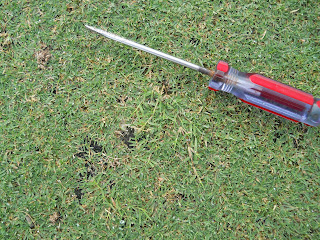
Although difficult to see, above is a picture of some 419 bermudagrass that has emerged on the surface. Just below the screwdriver you can see the 419 rising above the surface. The 419 has a longer leaf blade and a distinctive growth pattern. These traits help us to isolate it on the MiniVerde surface. We then remove the plant and repair the green like repairing a ball mark. On a typical day we may pull 20-25 weeds from the surface over four acres.
On Monday we applied an miticide to the greens. This product is designed to decrease nematode populations in the soil. Nematodes are a serious problem in turfgrass, especially in sandy soils. Here is a fact sheet on nematodes and the problems they present.
We also started fertilizing the tees, fairways and weak areas on Monday. We fertilized with ammonium sulfate (21-0-0). This fertilizer will improve the color, quality and vigor of the turf.
Next Week 7/29-8/4
Last Week 7/22-7/28
- Monday - We mowed the greens at a height of (.150"). We are holding steady at this height until the last week of the grow-in. We are still trying to fill in a few areas and the increased leaf surface will help to accomplish that.
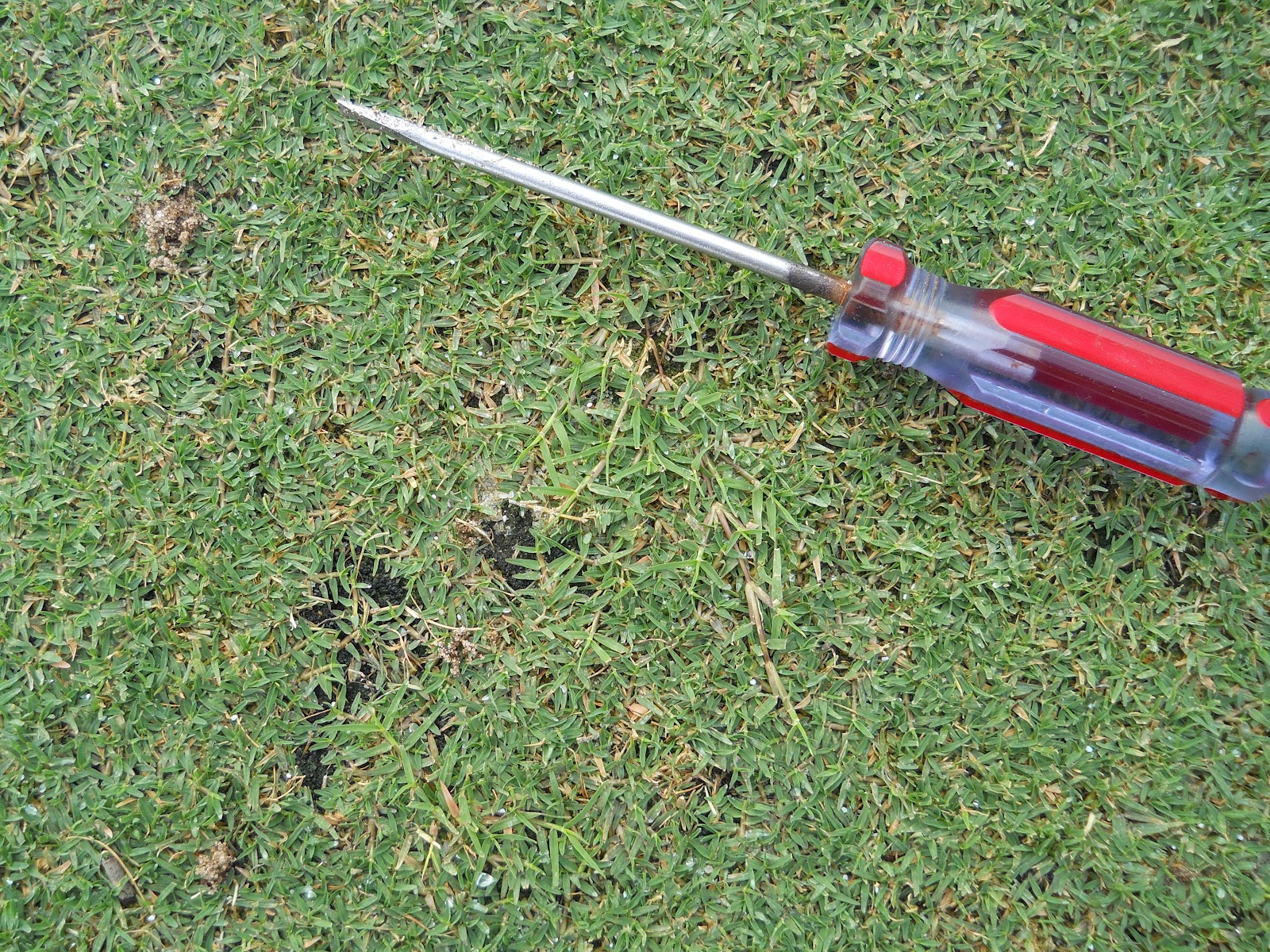
Although difficult to see, above is a picture of some 419 bermudagrass that has emerged on the surface. Just below the screwdriver you can see the 419 rising above the surface. The 419 has a longer leaf blade and a distinctive growth pattern. These traits help us to isolate it on the MiniVerde surface. We then remove the plant and repair the green like repairing a ball mark. On a typical day we may pull 20-25 weeds from the surface over four acres.
On Monday we applied an miticide to the greens. This product is designed to decrease nematode populations in the soil. Nematodes are a serious problem in turfgrass, especially in sandy soils. Here is a fact sheet on nematodes and the problems they present.
We also started fertilizing the tees, fairways and weak areas on Monday. We fertilized with ammonium sulfate (21-0-0). This fertilizer will improve the color, quality and vigor of the turf.
- Tuesday - Today we spiked, verticut, topdressed and fertilized the greens. The spiking was to break up the surface algae and allow the turf to cover in. The verticutting was intended to nick the MiniVerde plants, thus encouraging lateral growth. Finally the fertilizer we used was an (22-0-22) product designed to promote growth and replenish the potassium leached in the soil from increased irrigation.
- Wednesday - We mowed the surfaces today at a height of (.150"). As stated we will remain at this height until the surfaces are 95% covered.
- Thursday - Today we started our application of growth regulator to the course. We applied the growth regulator to all the turf sans the putting greens. This application will slow growth, therefore limiting scalping and improving turf quality.
- Friday - We wrapped up all of our ongoing projects today. We finished our fertilizer and growth regulator applications. We also made an application of gypsum (CaSO4) to the greens. The gypsum will aid in flushing the salts from the soil. The increased salts associated with increased fertilization can be extremely detrimental to the turf. We typically apply gypsum twice per year. This year may see an increase to four or five. Here is a website explaining the benefits of gypsum applications.
Next Week 7/29-8/4
- Continue mowing the greens at (.150"). A change in frequency may occur. Mowing everyday as opposed to every other may be necessary according to the health of the turf.
- Fertilize the greens. We will be applying Urea (46-0-0) in liquid form to the surfaces. The different chemistry in Urea will help us to benefit from microbial activity beneath the surface.
- Verticut the greens. One to two times as necessary
- Topdress the surfaces.
- Level sprinkler heads.
- Begin refinishing course hardware. (i.e. tees, 150 pole, etc..)
- Edge sand traps, cart paths, yardage signs, etc..
Thursday, July 12, 2012
Members Club Update
While we
have covered a lot of ground (literally), we still have a ways to go. There are
a few fairways that are concerning and are receiving our upmost attention.
Our plans
going forward are:
·
Spray
wetting agents to help keep the soil moist
·
Spike
and verticut to promote lateral growth
·
Topdress
with a sand/peat soil mixture to help hold moisture and smooth the surface
Other steps we
have taken include:
·
Ordered
new irrigation heads – same style heads as used throughout Reserve Club
-featuring improved precipitation rates
·
Purchased
and installed several new antennas for field satellite controllers. Also
purchased a new antenna for the base station to transmit an optimal signal.
·
Treated
fairways with a nematicide to help control excessive nematode populations
·
Mowing
with extremely sharp blades to reduce stress on the turf
·
Replaced
a well-pump used for irrigation on the Cate nine which had expired.
We also have
plans to beginning sodding some areas for quicker establishment.
Tuesday, June 19, 2012
Members Club - Nematode Report
Through the spring we've had some turf quality issues with Cate #1 and Cate #9 at the Members Club. Early on we attributed it to slow winter recovery. However, as temperatures rose and the days became longer we did not see the turf vigor that we anticipated. We took soil samples, fertilized and verticut these areas in hopes to stimulate a turf response. We did not see any such response. Our next step was to test for nematodes.
Nematodes are a parasitic insect that feeds on turf roots. They are microscopic insects that are not visible to the naked eye. Detection can only be observed through sample collection and laboratory testing. Here are a couple links explaining nematodes in more detail, link 1, link 2.
We submitted our samples to the North Carolina Department of Agriculture on June 5th. Our results were returned on June 7th. The results include our Assay Report, along with instructions and recommendations. Here is a sample of that form. Included on the results are, crop type, action codes, hazard index, and nematode type and counts.
The results of our samples from the Department of Agriculture came back with a high count of nematodes. Below is our "actual" report that we received.
.jpg) You can see in the report that our nematode counts are extremely high (>500cc soil). On the left side of the report is our site recommendations. The nematologist recommended action code C. This states that populations are high enough to provide substantial crop damage and chemical treatment is necessary. In the center of the report is the hazard index. This number is out of 100. Our index on Cate #1 and Cate #9 are between 70 and 100. These results put us on the higher end of the hazard index. This further verifies that treatment is necessary.
You can see in the report that our nematode counts are extremely high (>500cc soil). On the left side of the report is our site recommendations. The nematologist recommended action code C. This states that populations are high enough to provide substantial crop damage and chemical treatment is necessary. In the center of the report is the hazard index. This number is out of 100. Our index on Cate #1 and Cate #9 are between 70 and 100. These results put us on the higher end of the hazard index. This further verifies that treatment is necessary.
Moving forward we will make the proper treatments to control the nematode populations. Complete eradication of nematodes is almost impossible. Suppression is the best control option available for nematodes. However, methods of quality suppression are becoming sparser by the year. Most effective chemical controls have been removed from the market for EPA concerns. This leaves us with limited ammunition in the battle against nematodes. As time passes, newer, safer products are becoming available.
With that said, we will continue to educate ourselves on the newest products available. Through sales representatives, university studies and local golf course superintendents we will constantly be searching for the most effective, cost conscious products that enter the market for the conrol of nematodes.
Nematodes are a parasitic insect that feeds on turf roots. They are microscopic insects that are not visible to the naked eye. Detection can only be observed through sample collection and laboratory testing. Here are a couple links explaining nematodes in more detail, link 1, link 2.
We submitted our samples to the North Carolina Department of Agriculture on June 5th. Our results were returned on June 7th. The results include our Assay Report, along with instructions and recommendations. Here is a sample of that form. Included on the results are, crop type, action codes, hazard index, and nematode type and counts.
The results of our samples from the Department of Agriculture came back with a high count of nematodes. Below is our "actual" report that we received.
.jpg)
Moving forward we will make the proper treatments to control the nematode populations. Complete eradication of nematodes is almost impossible. Suppression is the best control option available for nematodes. However, methods of quality suppression are becoming sparser by the year. Most effective chemical controls have been removed from the market for EPA concerns. This leaves us with limited ammunition in the battle against nematodes. As time passes, newer, safer products are becoming available.
With that said, we will continue to educate ourselves on the newest products available. Through sales representatives, university studies and local golf course superintendents we will constantly be searching for the most effective, cost conscious products that enter the market for the conrol of nematodes.
Subscribe to:
Posts (Atom)