Showing posts with label stjames. Show all posts

Friday, July 25, 2014


Making our final push at Members Club. The Irwin front greens open next week.

Last Week 7/21/14 through 7/25/14

·        Again, we continued to lower the height on the mowers, making a couple cuts at .130 with the walk mowers.

·        Continued to topdress and fertilize.

·        Edged bunkers, beds and paths.

·        Sodded weakened and bare areas

·        Installed irrigation to alleviate wet approaches

Next week 7/28/14 through 7/31/14

·        Lower the height on Irwin front greens

·        Continue to topdress and roll for smoothness

·        A contractor will treat nematode infested areas such as around Cate #9 tees.

·        Stump removal throughout all three nines at The Members Club

·        Install a repeater to remedy our irrigation broadcast signal issues

·        Scalp, verticut, aerate and fumigate back nine Irwin greens to prepare for MiniVerde sprigging on August 7th.
Tylor rolling #9 Irwin green


Prisim gauge--used to analyze cut

Drew checking out prisim gauge

New sod along path # 1 Irwin
 

Friday, July 18, 2014

Last Week 7/14/14 through 7/18/14
·        Continued to lower height on mowers. With two weeks to go, we are now cutting at .165
·        We continue to push the greens with fertilizer to fill in the last few spots. We are very close to full coverage. Some greens are completely covered now. We believe the only areas that may require more time to fill in after we open are the perimeters, where the rough meets the green. (Photo below)
 
Next Week 7/21/14 through 7/25/14
 
·        Add key irrigation heads around several greens. Our goal is to eliminate soft approaches.
·        Continue to lower the height on greens mowers.
·        Fertilizer and sod bare areas


Tylor, a BCC Turf Management student, spreading fertlizer on new Irwin greens


While the greens may be completely covered, there may still be a slight gap left to
fill in between the green and the rough after we open on August 1st


Close up of MiniVerde greens at 42 days of growth

Irwin #6


Upcoming

·        Repair cart path from #18 Irwin to Clubhouse


Damaged cart path from Irwin #18 to Clubhouse
**Soon to be repaired**


Last Week 7/14/14 through 7/18/14

We were closed three days at Players Club to aerate the greens, which we did, but we also accomplished a lot more:

·        Stripped and leveled #7 tee on the bridge, then re-sodded. (Photos Below)

·        Edged all bunkers, yardage markers, cart paths and drains

·        Treated all fairways with a growth regulator

·        Repainted tee markers

·        Topdressed and double rolled all greens for smoothness

·        Mowed all rough


Renovating #7 Tee on the bridge at Players Club


Players Club #7 Tee
Stripped, leveled, sodded and added a border of pavers!

Friday, June 27, 2014


6/27/14


It's easy to see how much they've grown in three weeks!

Day 21
Irwin #6 Green


Day 17
Irwin #6 Green

Day 1
Irwin #6 Green


Day 21
Sprig Closeup


Day 17
Sprig Closeup

Last Week 6/23/14-6/28/16
  • We mowed the new greens two times this week. Once on Monday and again on Thursday. The first two cuts were at (.200"). Our plans are to incrementally lower the mowers until we reach our desired mowing heigth. With the growth we are getting, we'll be mowing everyday in no time!
  • To continue growth and lateral coverage, the greens were fertilized twice and watered throughout the day.
  • After our Monday mowing, we topdressed the greens with a sand/peat blend. Then dragged in the mix with a brush. The topdressing will help fill the voids and smooth the surface.

Next Week 6/30/14-7/4/14
  • Continue to mow, fertilize and topdress the greens.
  • Re-level and sod forward tee on Irwin #5 and middle tee on Irwin #8 (Photos next week)
  • Slice and spike thin area in the fairways and tees. Also hit with fertilizer for quick coverage.


Wednesday, May 28, 2014

MC Conversion Update - 5/28/14


     The conversion from Tifdwarf to MiniVerde has officially started. We are thrilled to have Day One in the books. Mother Nature blessed us with perfect weather. Mid 80s. Sunny. Breezy. Cleanup after verticutting and aerifying went very well.
     We plan to keep the updates coming along with a recap of we've accomplished. Stay tuned!

     Below are a few photos from yesterday's action. Our goal was to remove as much of the old vegetation as possible.

Adam - verticutting the greens - five different directions!


Ed and (Drew in the background) blowing off debris after verticutting


Pushing off plugs after aerifying--two directions.

Friday, May 16, 2014

PC Closed Day

       The Players Club was closed Tuesday afternoon and all day on Wednesday. The main reason for closing was to apply a soil fumigant to the greens. This application targeted the parasitic nematodes that are abundantly present in our greens soil. The fumigant application was applied Tuesday afternoon and required a 24 entry restriction. We used this closed time to complete other time consuming tasks as well.
        Tuesday afternoon, following LGA, we began the Curfew application. This product was applied by Southern Soils via Harrell's LLC. We will post a detailed description of Curfew and its effects next week. Here are some pictures of the application in progress.

The applicator is attached to the rear of the tractor. It is injected into the soil as a liquid. It then volatilizes as a gas and moves throughout the soil and kills the nematodes on contact.

You can see the slits being cut into the soil. This is the site where the liquid is injected. We roll and water immediately after to ensure the slits are sealed.
       The pictures illustrate the application process. Our actions immediately following the application are what guarantee the success of the fumigant.

Associate Juan Diaz Garcia rolling the surfaces.


      Immediately following the application we rolled the greens. The rolling helps to reseal the slits made by the applicator. We then irrigate the greens with a moderate amount of water, roughly one-tenth of an inch. These processes aid in sealing the slits and keeping the gases at the target site. We then continue to water frequently for the next 24 hours. Once play resumes on the course, the active ingredient has mostly dissipated and it has already moved throughout the soil profile. 
      On top of fumigating the greens we were also able to tackle some other management practices during our closed period. 
      The most labor intensive area on our golf courses are the bunkers. Daily raking, mowing the faces, edging and redistributing sand are extremely arduous tasks. Coupled with active golfers, the amount of time to complete these jobs can be tripled. We took advantage of our "golfer free" course to mow the faces, edge and clean all the traps on the property. This took our staff half of the day Tuesday and all day Wednesday. This process is typically done once a month. 
       We fertilized the rough with ammonium sulfate fertilizer Wednesday morning. This will help to jump start the turf to aid in filling in some weak areas. We use 21-0-0 because of the rapid response and cost effectiveness. You should begin to notice the results within three to five days. 
      Wednesday afternoon we sprayed all the broad leaf weeds on the golf course. Broad leaf weeds can be an eyesore to any golf course, especially in the spring while the bermudagrass is returning from dormancy. We completed the spraying of 40+ acres in three hours. A task that can take four to five afternoons was finished with ease while we were closed.
       And last but not least we topdressed the greens with a medium coating of 100% sand. Because of our weak greens in April we have been fertilizing regularly. This causes flushes of growth. The growth leads to more leaf surface, which in turn will lead to a "thatchy surface". The topdressing sand helps to dilute the thatch and provide a smoother ball roll. Topdressing is an integral part of managing a good putting surface.
      As you can see, we accomplished a lot during our closed period. We understand the closing takes away from the golf schedule. We also understand that our membership loves to golf. We cannot state enough how appreciative we are to have closed periods during the growing season. This helps us complete work more effectively and efficiently. The result is a quieter and better looking golf course. Again, we appreciate your patience and understanding when we close our golf courses.


Thursday, May 8, 2014

Seaside Opening

     The new tennis facility at Seaside plans to open next weekend. In light of the opening, the agronomy team decided to provide a peek at whats happening now. Terry Gottshalk's landscape team and some outside contractors has been working diligently to ensure we are perfect on opening day. Here are some photos taken on Tuesday, May 6th. They were in the process of installing concrete walkways, irrigation and landscaping. Although there is still work to be done, we are confident in opening up next weekend.
Distant photo of the Center courts. You can see the walkways being completed.

Court #3 with a small set of bleachers. 

Tennis lesson and practice area.

The bleachers next to the Center courts.

Close-up shot of the Center courts.

Installing irrigation.

Some completed walkways and landscape areas surrounding the courts

Midway road side of Seaside. Still a fair amount of work to be done.

Saturday, March 15, 2014

Reducing the shade at the PC, where we stand..

       Last fall we collected data regarding sunlight amounts and the negative effects they have on turf. We showed you, with factual data, that sunlight is crucial to the success of MiniVerde putting surfaces. Our data coincided with each green's performance level. Optimal sunlight conditions produced the highest quality putting surfaces, where conversely, poor sunlight amounts resulted in poor turf quality. This initial post and original data can be found here.
       We have been working at improving our average annual sunlight totals since January. Below is an interactive excel chart that displays our data. You can navigate through the sheet just as you would working on your own document. In the chart you will see the totals from December 2013 and our current amounts. This spreadsheet is also available to download for easier viewing.


       This year we have concentrated our efforts to increasing our annual averages to above nine hours. We have removed trees from hole #'s 7, 10, 11, 14 & 17. Overall we gained 348 minutes of average daily sunlight. Here is a breakdown of our site specific increases.

  • (#7) ---> + 11 minutes
  • (Front Right #7) ---> + 51 minutes
  • (#10) ---> + 2 minutes
  • (Back Right #10) ---> +18 minutes
  • (#11) ---> +14 minutes
  • (#14) ---> +41 minutes
  • (Front Left #14) ---> +54 minutes
  • (#17) ---> + 47 minutes
  • (Front Right #17) ---> +110 minutes
     
       The information above shows that we are making progress, but the spreadsheet still indicates we have some work to do. We plan to continue our tree removal program through the month of March. We intend to work on the back right of #9 and #'s 10 & 11. Please download the application above and as always feel free to contact us with any concerns.

Thursday, January 30, 2014

How much sunlight is enough?

       Its common knowledge that grass needs sunlight to grow. Sunlight is absorbed by the turf and used to release oxygen and reduce carbon dioxide into energy. This energy is used for various vital plant functions. But how much sunlight does a plant need? Ten hours? Twelve? More sun in the morning? Or the afternoon? We set out to answer these questions and provide solutions with regards to our MiniVerde greens at the Players Club.
       We downloaded a sun path application to our smartphones to chart the amount of sunlight our green's are receiving. This application can be found here. The goal was to quantify the sunlight amounts. We wanted to gain some perspective into the sunlight debate. What we found was that turf needs adequate sunlight all season. Even when the turf is dormant, seven hours of sunlight is necessary for optimal surface conditions.
     We collected our information from 27 points over the nineteen putting green's. We took readings from the center of every green, then added eight other points of reference. The supplemental sections are our trouble spots from this past season. We wanted to cross-reference good vs bad in hopes of drawing conclusions as to why certain green's struggle more than others. What we found was that 95% of our problem areas are directly related to average sunshine.
          Below is an excel spreadsheet of the data that we observed. It is not the raw data; but averages calculated from the sun's patterns throughout the season. There are five columns. The first is an average for the entire year. The second through fifth columns are averages from the four trimesters of the year, January-March, April through June, July through September and October through December, respectively. The spreadsheet is interactive, so you can scroll through to see all of our statistics.


        When we first calculated the averages we took a "which one isn't like the others" approach. This helped us to arrive with a target value for each column to compare. The first column (12 month average) we concluded that a value greater than nine hours was our benchmark. We repeated this step until we found a target value for each column. These values are highlighted in blue.
        Our next step was to highlight every value that fell below our benchmarks in each column. We highlighted these values in yellow. Once we had the color contrast to visualize we came to the immediate conclusion that our average sunlight needs to increase. But what was more interesting were the highlighted cells versus the non-highlighted cells.
        The first five greens at the Players Club were by far our best performing greens. Now you can look at the chart and see these five greens have only one highlighted cell. Is this a coincidence? No, absolutely not. These greens meet all our minimum requirements of average sunlight throughout the day for the entire year. This discovery only strengthened our beliefs that reduced sunlight directly impacted green's performance.
        As you continue down the chart you can see the correlation between turf quality and average sunlight. But which sunlight is most important? Some turf professionals will tell you, clear everything from the hours of 9 AM to 3 PM on December 21st and your troubles will be gone. However, our study has found that its not as "clear cut" as that. Let's use the back of #9 green for example. It has full sun on December 21st from 9:00 AM until 4:30 PM. That is seven and a half hours of sunlight on the shortest day of the year. Yet the 12-month average is still 30 minutes below our acceptable limit. As we look at our chart we see that this green averages 20 minutes below our limits from January through March. The average daily sunrise for this green is 9:30 AM during these months. So, from this we concluded that the simple, somewhat vague answer to the "What sunlight is the most important?" question is: All of it. We feel that maintaining an average, consistent with our "target values", over the entire year is the goal.
        Our next step is to implement a plan to increase our annual sunlight averages. We begin by singling out the undesirable figures from column one.  We then scroll horizontally to find out when sunlight is most restricted. These figures are highlighted in red. We take these figures to the field and pinpoint the limiting factors. Let's look at the front left of #14 as an example.
        The data provided shows us that the front of #14 receives 8 hours and 33 minutes of sunlight, on average, throughout the year. This is below our nine hour threshold. We then scroll right and find the lowest average trimester; that is January through March. During these months, the green's surface averages 7 hours and 40 minutes of sunlight per day. This is below our desired level of 8 hours at this time of year. This amount is the limiting factor regarding our annual average. We must now travel to the site and plan our removal strategy.
        Once on site, we use our Sun Surveyor application to target the specific trees for removal. We program the app to show the sun's path during our limiting months. The path is then traced over the actual landscape on the smartphone's screen. We can now pinpoint the exact tree(s) that need to be removed and reduce removing unnecessary plant life.
       We plan to use this process to scout tree removal over the remainder of the winter. We will be diligently working to remove limiting factors to ensure premium putting surfaces next season. The use of smartphone technology and our collected data allows us to remove trees with maximum efficiency. This allows us to complete our work in a timely manner and reduce disruption to the golf schedule. Over the next few months we will be continuing to improve our sunlight averages. You can use the spreadsheet above to follow along and determine exactly why and what we are removing.

Friday, December 13, 2013

Bunker Repair

       The front green side bunker on #15 at the Players Club has slowly eroded of the past few seasons. The erosion has negatively affected playability and created a maintenance nightmare. This week we removed the sand and misplaced gravel and refilled the bunker with new, higher quality sand. Here are some pictures of our work.

Here is a picture of the stones that are hit out of the bunker onto the green. Everyday we have to blow the stones before we can mow the green. This adds unnecessary maintenance time and creates poor putting surface quality.

Here is a slightly better picture of the stones on the turf.

The first step was to remove all of the existing sand from the bunker. The picture shows the sub layer of sand just above the drainage tiles.

Here is a photo of the bunker face after sand removal.


The finished product.
       This project took three days and 100 man hours to complete. We intend to repair the green side bunker on #17 next. We understand these bunkers are difficult to play from and we appreciate your patience while we work to restore them.

Friday, December 6, 2013

Players Club #18 fairway


      The 18th hole at the Players Club will be placed on "cart path only" status for the next few days. We are in the process of reestablishing the neck area of the fairway. We reseeded this week and need to keep traffic to a minimum to encourage germination. We anticipate "cart path only" rules through this weekend and into early next week.
       Here is a picture of #18 at the Players Club. The highlighted section is the neck area in which we are referring. This section receives a great deal of traffic and the poor turf quality reflects that. We have reseeded this portion of the fairway and expect germination within the next few days.  We thank you for your patience as we work to restore this segment of the fairway.


Friday, November 22, 2013

Carolina's Trade Show 2013

       November is the time of year when the air begins to cool, the turf is entering dormancy and winter projects are beginning.  It is also the time of year for the Carolina's Golf Course Superintendents Conference and Trade Show. This year's conference took place from Monday through Wednesday of this week. It is held at the Myrtle Beach Convention Center every season. This event is the second largest of its kind and only the GCSAA national show exceeds it.

         All of the Superintendents and Assistants attend the Conference and Trade show every year. We attend classes on Monday afternoon's and all day on Tuesday, followed by the trade show Tuesday evening. The classes that are offered range in topics from setting up the golf course to managing pests. This years list of classes is below:


  • Three perspectives on Ultradwarf Bermudagrass
  • Demystifying Turfgrass Pathology
  • Advanced Weed Management
  • Plant Growth Regulators for Fine Turf
  • Event Management and Golf Course Preparation
  • Managing Turfgrass Root Systems in Southern /Transition Zones
  • Winter Management of Ultradwarf Bermudagrass Putting Greens
  • New Products for Annual Bluegrass Control
  • Insect Control in Tropical & Semi-Tropical Environments
  • Using Wetting Agents on the Golf Course
  • Aquatic Plant Management for Golf Course
  • Irrigation Water Quality
  • Fertility Management 
        The classes are each three and a half hours long and are presented by speakers from all over the world and from all facets of golf course management. Some of the presenters included:
  • Fred Yelverton, PhD, NC State University
  • Tim Moraghan, Principle, Aspire Golf Consulting
  • Keith Karnok, PhD, University of Georgia
  • Bruce Williams, President, Williams Golf Consulting
  • Tony Mancuso, Director of Operations, Cherokee Town and Country Club
  • Dick Schulz, Owner, The Oaks Course
  • Mike Goatley, PhD, Virginia Tech University
  • Bert McCarty, PhD, Clemson University
  • Robert N. Carrow, PhD, University of Georgia
  • Grady Miller, PhD, NC State University
  • Douglas Karcher, PhD, University of Arkansas
  • Bruce Martin, PhD, Clemson University
  • Patrick O'Brien, Director, USGA Green Section
  • Chris Hartwiger, Agronomist, USGA Green Section
  • Shawn Askew, PhD, Virginia Tech University
  • Rick Brandenburg, PhD, NC State University
  • Chris Carson, GCS, Echo Lake Country Club, New Jersey
       We had thirteen people at the event and we were able to cover most of the classes. We typically split up to get the most bang for our buck. We are also able to ensure pesticide re-certification with the credits offered at each event. Overall, the conference recaps of what has transpired through the season, updates us on new products and serves as a refresher on some things we may have forgotten since college.

Thursday, November 14, 2013

Winter projects

       Since winter decided to come a little early this year we have been able to get a jump start on some off-season projects. A few projects that never seem to go away are the leveling of sprinklers and drain inlets. This hardware is located all over the property and often times comes into play. This makes the leveling task hard to accomplish in the middle of the busy summer.
       The first drain that we addressed was located in the small fairway on #16. We extended this drain two years ago, however it has since sunk another six inches. This causes an unsightly and unplayable depression in the fairway and forces unnecessary wear and tear on our equipment. The pictures below shows what we did and how we've adopted a sleeker method to extend the life of the new extension.

Former grading with new drain extension.

Drain inside larger "form" pipe for gravel channel installation.

Added soil for leveling surrounding grade and securing our gravel channel.

Close-up of gravel channel after we removed our 10" channel form.

Drain extension and leveled grade.

Finished product.

Monday, November 11, 2013

Mole on #5 green at The Players

       Anybody that has played the Players Club recently is aware of the scene below.


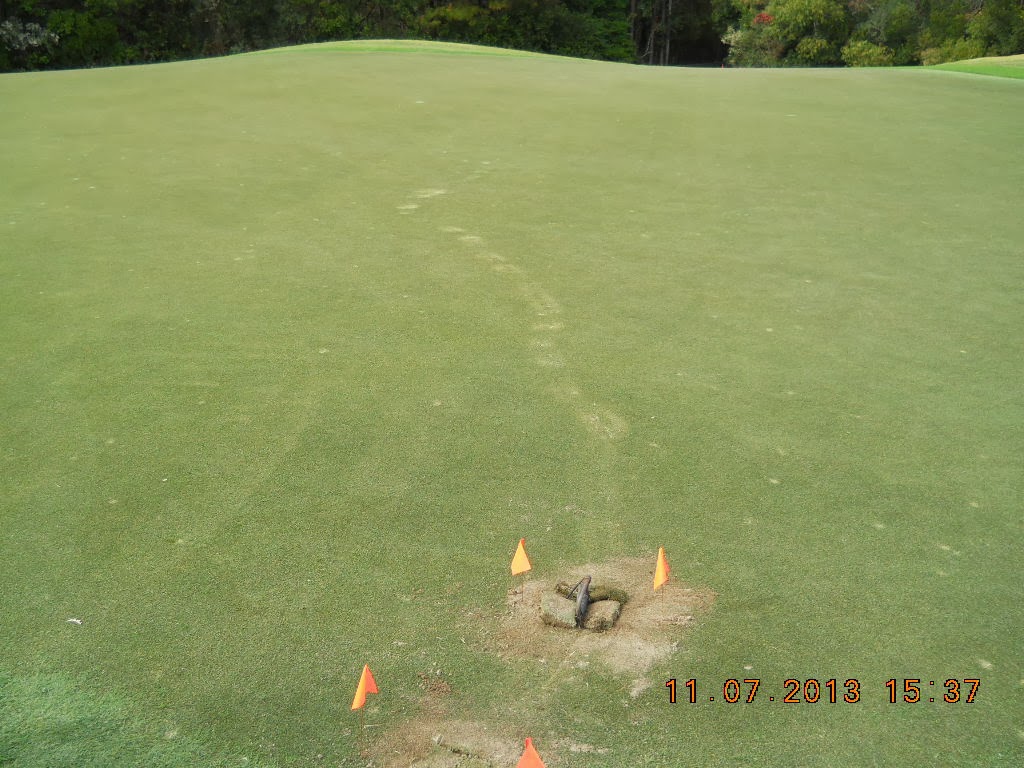
       We have a mole that has decided to gather his meals from our green. He has trenched on to the green, roughly twenty feet. We have set multiple traps along his trail in front of and on the green. Please be patient with us until we are able to catch him or scare him away. Until we are sure that he has vacated the green's complex, the traps will remain. We recommend using local rules in determining how to play shots that are affected by the trap and trail.


Tuesday, October 15, 2013

Fairy Ring disease

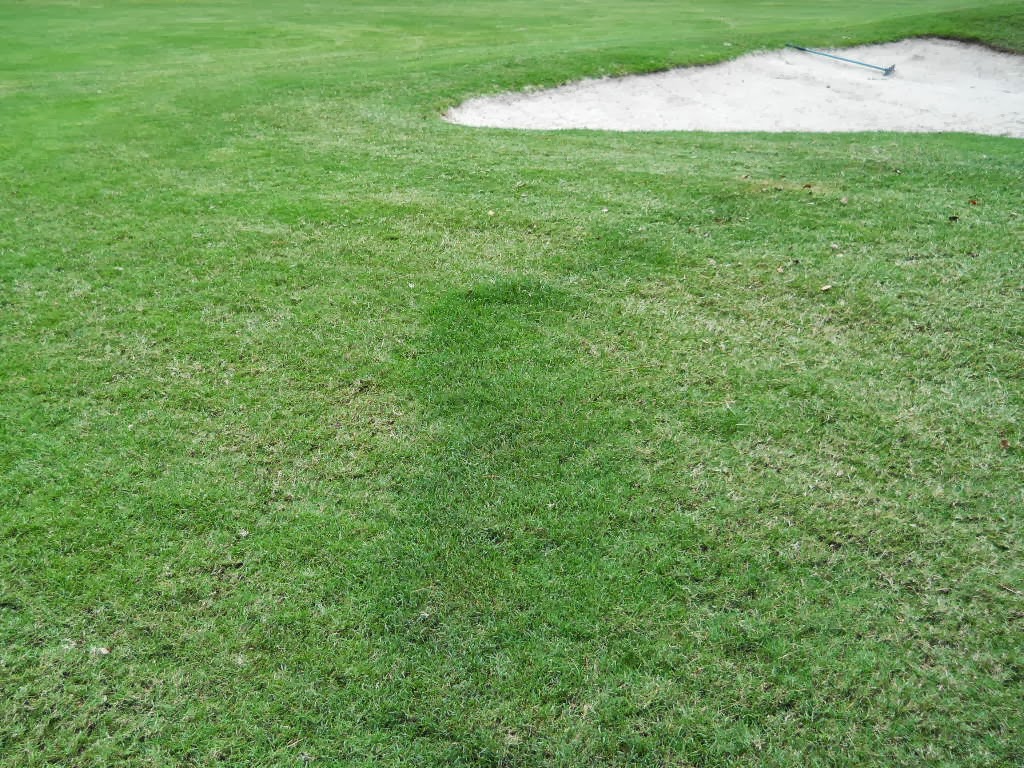
       Anyone who has played golf regularly has seen the disease in the pictures below. This disease is called Fairy Ring.  Fairy ring is particularly prevalent in sandy soils with inadequate moisture and low fertility.


          Fairy ring is caused by a fungus that lives in the soil that feeds on decaying organic matter, ( Items perhaps buried during construction, i.e. tree stumps, roots and logs) The dark green colored circle is caused by an excessive release of nitrogen from the fungus feeding on the decaying matter. The circular shape is caused from the fungi moving outward in search of more nutrients. Preventative and curative options are extremely expensive for the control of fairy ring. We allocate our fungicide budgets to reduce damage from the most important sites on the golf course, i.e. greens > fairways > tees > rough.
      The main causes and cures are well known to turf specialists now, however that was not the case many years ago. There is certainly a fair share of folklore associated with fairy ring.  Here is a website detailing the myths that have been associated with fairy ring over the past thousand years.

Thursday, October 10, 2013

Blue dots around the greens..

       You may have seen the blue dots along the edge of the greens since we converted the surfaces. This isn't a new process here at St. James. We have always marked the edges, even when we had clearer
definition with the bentgrass. The only difference now is the increased importance of keeping the original green-collar interface.

        
        When we resurfaced the greens last season we needed to located the original edges of the greens. Here is a  link to our summary video from two years ago. The 419 bermudagrass can be very invasive under the right conditions, especially when competing with bentgrass. Although the new MiniVerde surfaces growth habit is relatively the same, the management practices at the collar interface demand that we keep our edges marked. 
        Another factor in marking the edges is to maintain the original shape of the green. Below you can see a picture from the sixth green. This is the original green shape.  
        

        Often times our mowers tend to mow into the collars on sharp curves. This causes the putting surface and collar to lose their shape. Here is a edited photo of what can gradually happen if we do not mark the edges.


       Once we begin to mow into the collars we lose perspective of the original green size and shape. Now that we have located the original edges it is our job to insure that we don't lose them again. Painting the edges with blue dots, on a regular basis, helps everyone stay on the same page to keep the greens consistent with the original architecture.